


The global debate over climate change is increasingly centred on a difficult question: how quickly can countries reduce their dependence on oil, gas and coal without undermining their economies and energy security?
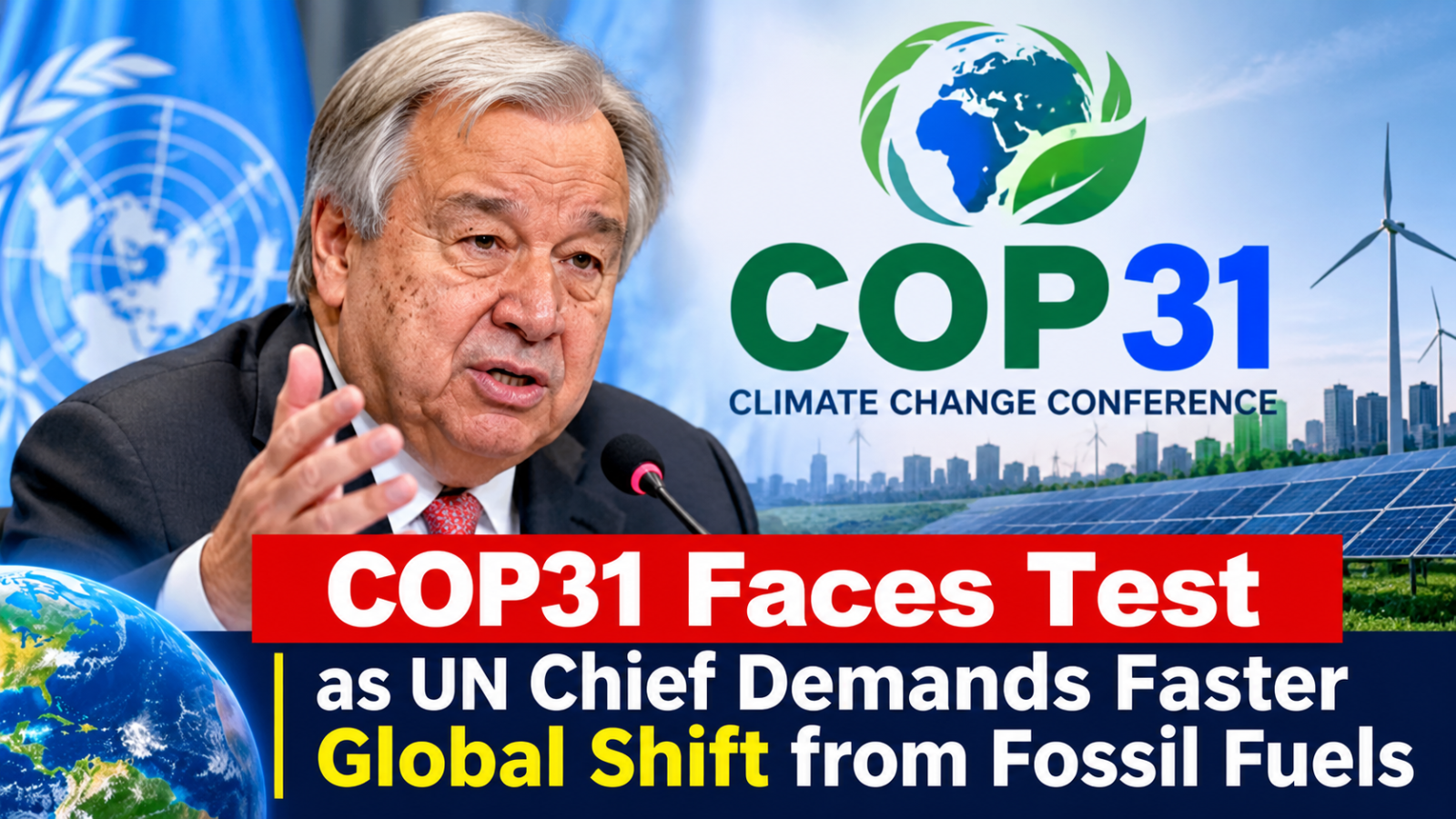
That challenge is taking centre stage at the 31st United Nations Climate Change Conference (COP31) in Antalya, Turkey, where UN Secretary-General António Guterres has called on governments to accelerate the transition away from fossil fuels and confront the influence of companies benefiting from continued dependence on them.
Addressing world leaders on Wednesday, November 11, Guterres argued that the case for continued reliance on fossil fuels was becoming increasingly difficult to defend. He urged countries to establish clearer timelines for reducing their use, warning that delays would increase the economic and environmental costs of climate change.
He called for coal to be phased out within approximately 15 years and for oil and gas consumption to fall substantially. He also proposed taxing extraordinary profits made by fossil fuel companies to help vulnerable countries recover from climate-related disasters.
His intervention places pressure on governments attending the summit to move beyond general commitments and demonstrate how they intend to deliver measurable reductions in emissions.
The challenge of turning climate promises into action
The urgency surrounding the negotiations reflects the growing gap between international climate commitments and the pace of implementation.
Under the 2015 Paris Agreement, countries committed to pursuing efforts to limit global warming to 1.5 degrees Celsius above pre-industrial levels. However, the world is already facing the consequences of rising temperatures, including more destructive wildfires, floods, droughts and extreme heat.
The 1.5-degree target has been breached on a temporary basis, although this does not mean the long-term threshold has formally been declared permanently exceeded. Scientists maintain that rapid emissions reductions remain essential to limiting further warming.
The challenge is also political. Governments remain divided over how quickly fossil fuel production should decline, who should finance the transition and how developing economies can expand access to energy without increasing their emissions.
At COP31, Brazil’s President Luiz Inácio Lula da Silva backed national roadmaps for moving away from fossil fuels and ending deforestation. He also warned that international attention was increasingly being diverted towards conflicts, weapons and trade disputes instead of the climate crisis.
The limited attendance of leaders from major polluting countries has added another complication. An analysis of the summit’s scheduled high-level speakers found that national leaders expected to attend represented only about 14 per cent of global carbon dioxide emissions. The absence of leaders from China, the United States, India, Russia and Japan raises questions about the political weight behind the negotiations.
Why electrification has become a major negotiating issue
One of the important proposals being discussed at the summit is a push to increase electricity’s share of global energy consumption.
Turkey and Australia are promoting a voluntary target to raise electricity’s share of global final energy demand from approximately 23 per cent currently to 35 per cent by 2035.
Electrification involves replacing technologies that depend directly on fossil fuels with electric alternatives. Examples include electric vehicles replacing petrol-powered cars, electric heat pumps replacing gas heating systems and factories adopting more efficient electric equipment.
The economic argument is that electricity can be generated from renewable sources such as solar, wind and hydropower, reducing dependence on imported oil and gas.
However, electrification does not automatically guarantee lower emissions. If additional electricity is generated mainly from coal and gas, the environmental benefits will be limited.
The proposal therefore raises a critical question: can countries expand electricity consumption while simultaneously increasing the share of clean energy in their power systems?
What the climate transition means for Africa and Nigeria
For developing economies, particularly across Africa, the transition presents both opportunities and significant financial challenges.
Africa accounts for a relatively small share of historical global emissions but faces serious exposure to climate-related risks, including agricultural disruption, water shortages, extreme weather and damage to infrastructure.
Electricity access is another major obstacle. Estimates presented during the COP31 discussions indicate that electricity accounts for only about 12 per cent of final energy use in Africa, while approximately 600 million people across the continent still lack access to electricity.
This means the continent must pursue two objectives simultaneously: expanding reliable energy access and building systems that can support long-term economic development with lower emissions.
For Nigeria, the issue is particularly important because oil and gas remain central to government revenue, foreign exchange earnings and economic activity.
A global reduction in fossil fuel dependence could eventually affect demand for Nigerian crude oil and influence investment decisions across the petroleum industry. At the same time, expanding renewable energy could create opportunities in electricity generation, manufacturing, infrastructure and technology.
However, those opportunities will depend on financing, reliable electricity networks, affordable technology and policies that encourage investment.
Developing countries have consistently argued that wealthy nations, which account for a much larger share of historical emissions, should provide greater financial support for climate adaptation and the transition to cleaner energy.
The real test is implementation
Guterres’ intervention reflects a wider frustration with international climate negotiations: countries have made commitments, but translating them into measurable action remains difficult.
For economies dependent on fossil fuels, the transition involves difficult decisions about jobs, public revenue, energy prices and industrial competitiveness. For poorer countries, the cost of building new energy infrastructure can be a major obstacle.
COP31 must therefore address more than the need to reduce emissions. It must also confront how the transition will be financed, how affected workers and communities will be protected and how developing economies can secure affordable energy.
The success of the summit will ultimately depend not on the strength of speeches but on whether governments agree on practical steps that can be implemented and measured.
For Nigeria and other developing countries, the outcome will matter not only for the environment but also for future investment, energy security and economic growth.









Leave a comment