


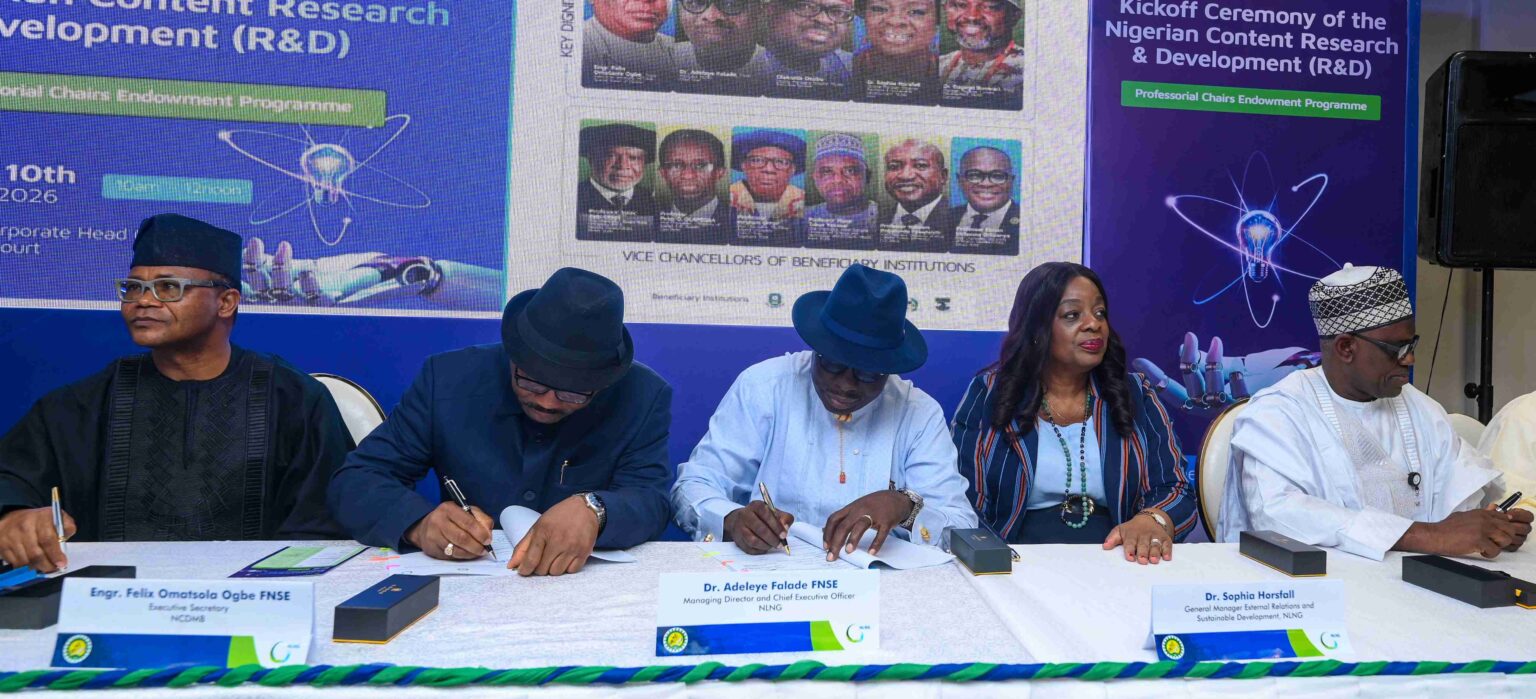
Nigeria’s efforts to strengthen local research and develop home-grown industrial technology have received a $9 million boost, following a partnership between Nigeria LNG Limited (NLNG) and the Nigerian Content Development and Monitoring Board (NCDMB) to establish specialised research chairs in six universities.
The commitment, valued at approximately ₦12.78 billion, will provide $1.5 million, equivalent to about ₦2.13 billion, to each beneficiary institution under the Nigerian Content Research and Development (NC-R&D) Professorial Chair Endowment Programme.
The universities are expected to use the funding to develop research capacity and produce practical solutions to challenges facing Nigeria’s oil and gas industry and other related sectors.
The beneficiary institutions are the University of Ibadan, Rivers State University, Modibbo Adama University (MAU), Yola, Aliko Dangote University of Science and Technology, Kano, University of Nigeria, Nsukka, and Yakubu Gowon University, formerly the University of Abuja.
For Adamawa State, the inclusion of Modibbo Adama University places the institution among six universities selected to participate in a research programme targeting some of the country’s industrial and technological priorities.
What the ₦12.78 billion will fund
The initiative will establish specialised professorial research chairs focusing on areas identified by the participating institutions and their industry partners.
Rather than concentrating exclusively on academic publications, the programme is designed to encourage research that can be tested, developed and eventually applied to practical industrial challenges.
NLNG Managing Director and Chief Executive Officer, Adeleye Falade, said the energy industry was undergoing technological changes that made sustained research and innovation increasingly important.
He identified operational efficiency, emissions management, industrial safety, critical infrastructure and sustainable production processes as areas requiring stronger research capabilities.
Falade also highlighted opportunities for collaboration through academic exchanges, specialised training, sabbatical programmes, practical research and joint postgraduate curriculum development.
The NLNG Research and Innovation Centre for Computer and Electrical Engineering at Rivers State University is expected to serve as the coordinating centre for collaboration among the six institutions.
He disclosed that discussions were ongoing with the university on implementation arrangements. He also said prospective partners, including Google, Cisco and MTN, had indicated interest in supporting the initiative.
Research priorities across the six universities
Each institution will concentrate on specific research areas linked to its programme.
The University of Ibadan will focus on natural gas processing, pollution control and environmental management, while Rivers State University will undertake research in digital engineering, intelligent energy systems, automation and asset integrity.
Modibbo Adama University will concentrate on energy transition and the environment, an area increasingly relevant to discussions about cleaner energy systems and the future of industrial development.
Aliko Dangote University of Science and Technology will work on sustainable energy innovation and climate-resilient food systems.
The University of Nigeria, Nsukka, will focus on green energy production and geoenvironmental engineering, while Yakubu Gowon University will undertake research in geoscience and satellite intelligence for resilient gas infrastructure.
The different research priorities are intended to bring specialised academic expertise into areas where Nigeria requires stronger technological capacity.
NCDMB wants research translated into industrial solutions
Executive Secretary of the NCDMB, Felix Omatsola Ogbe, described the endowment as an investment in the country’s research and innovation ecosystem.
Represented at the programme by his Senior Technical Adviser, Austin Uzoka, Ogbe said the initiative complemented the board’s existing investments in research infrastructure, including specialised research and development centres in six universities.
He urged the beneficiary institutions to move beyond research primarily undertaken for academic publications and focus on findings that can address practical industrial problems.
The universities will be expected to establish clear research objectives, deliver measurable outcomes, manage the resources responsibly and maintain partnerships with relevant industries.
The programme also provides for minor infrastructure upgrades to prepare designated university spaces for research activities.
In addition, proposed arrangements will allow industry professionals to contribute practical expertise while pursuing postgraduate qualifications, including master’s and doctoral degrees.
The challenge is turning research into commercial value
The partnership addresses an important gap in Nigeria’s research environment: the distance between academic discoveries and their adoption by businesses and industries.
Universities produce research findings, but translating those findings into commercially useful products, industrial processes and technologies requires funding, specialised equipment, technical expertise and sustained engagement with the private sector.
For Nigeria’s oil and gas industry, stronger local research capacity could support efforts to improve operational efficiency, manage environmental challenges, strengthen infrastructure and reduce dependence on imported technical solutions.
The programme’s impact, however, will depend on how effectively the participating universities manage the endowments and convert research activities into practical results.
For Modibbo Adama University, the energy transition and environmental research focus also presents an opportunity to strengthen its contribution to national scientific development and build closer relationships with industry.
The ₦12.78 billion commitment therefore represents more than funding for academic positions. Its longer-term value will depend on whether the research produces technologies, skilled professionals and solutions that Nigerian industries can actually use.









Leave a comment