


Nigeria’s economy is showing signs of recovery, government revenues have improved and investor confidence has received a boost. Yet, for millions of Nigerians, the cost of feeding a family, paying for transportation, keeping a business open and meeting other basic expenses remains a daily struggle.
That gap between improving economic indicators and the financial realities of households is at the centre of a promise made by Minister of Budget and Economic Planning, Senator Abubakar Bagudu, who says President Bola Tinubu’s economic reforms have laid the foundation for shared prosperity.
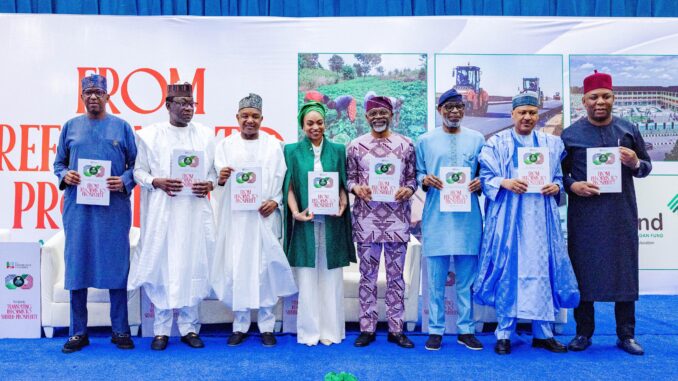
Speaking on Tuesday, November 10, 2026, at the presentation of the All Progressives Congress (APC) 2027 presidential election manifesto in Abuja, Bagudu said the difficult period associated with the administration’s reforms was giving way to a new phase of economic opportunity.
The manifesto, titled From Reforms to Prosperity, sets out the party’s proposed direction for the next four years. Bagudu, who chaired the committee responsible for the document, argued that the government’s decisions had strengthened private-sector confidence, attracted investment and created conditions for a more prosperous economy.
His assurance, however, raises a question that goes beyond political promises: how soon will the benefits of these reforms become visible in the lives of ordinary Nigerians?
What have the reforms actually achieved?
Since taking office in May 2023, Tinubu’s administration has introduced major changes to Nigeria’s economic management.
The removal of petrol subsidies and the liberalisation of the foreign exchange market were among its most consequential decisions. The government argued that the previous arrangements placed an unsustainable burden on public finances, encouraged market distortions and limited the resources available for infrastructure and public services.
The reforms have changed the country’s fiscal position and foreign exchange arrangements. Government revenue has increased, while the naira’s foreign exchange market has become more unified than it was under the previous system.
There are also signs of improved economic activity.
Nigeria’s real gross domestic product grew by 4.43 per cent in the second quarter of 2026, compared with 4.23 per cent in the corresponding period of 2025.
Headline inflation declined to 14.63 per cent in September from 15.39 per cent in August. The improvement suggests that the rate of price increases has slowed.
These developments matter. A government struggling with weak revenue, persistent foreign exchange shortages and heavy fiscal obligations has limited capacity to invest in infrastructure, support businesses and provide essential services.
However, economic recovery cannot be judged by growth and inflation figures alone.
Why lower inflation has not ended the cost-of-living crisis
One of the most important distinctions in understanding Nigeria’s economic situation is the difference between falling inflation and falling prices.
When inflation declines, prices generally continue to rise, but at a slower rate. It does not mean that food, transport, rent or other essential expenses have returned to what households paid before the recent period of sharp increases.
That distinction explains why a lower inflation rate may not immediately translate into financial relief.
Food inflation stood at 19.59 per cent in September, considerably above the headline rate. For households that spend a large proportion of their earnings on food, this remains a serious pressure.
The consequences extend beyond the market. Higher food expenses leave families with less money for school fees, healthcare, housing and other necessities. Transport costs also affect workers who must travel daily, while businesses face pressure from energy, logistics and financing expenses.
For small businesses, the challenge is particularly important. A more stable foreign exchange market may improve planning, but manufacturers and traders still need affordable credit, reliable electricity, predictable policies and customers with sufficient purchasing power.
A growing economy does not automatically mean that every household is becoming better off. The distribution of economic gains matters.
The poverty figures show the scale of the challenge
The International Monetary Fund’s 2026 assessment of Nigeria provides an important perspective on the distance between economic stabilisation and improved living standards.
The IMF estimated that poverty had reached 63 per cent under Nigeria’s national poverty line. It also estimated that 27 million Nigerians faced food insecurity in the autumn of 2025.
These figures underline the scale of the welfare challenge confronting the government.
They do not mean that the reforms have produced no benefits. The IMF has acknowledged that the policies introduced over the past three years have improved macroeconomic outcomes and strengthened economic resilience.
But the institution has also warned that conditions remain difficult for many Nigerians.
This is the central test facing the administration: whether improvements in public finances and economic stability can translate into higher real incomes, productive employment and a reduction in poverty.
Where is the money from subsidy removal going?
The question of what happened to the resources released by subsidy removal is also important.
The Federal Government’s own reform scorecard estimates that subsidy savings across the federation amounted to approximately ₦15.8 trillion over the period covered by its assessment.
However, the entire amount did not belong to the Federal Government. It was distributed among the three tiers of government through the Federation Account.
The Federal Government’s estimated share was ₦5.43 trillion. When combined with other incremental revenue and additional borrowing, the government calculated that it had approximately ₦20.4 trillion in incremental resources.
Its reported additional expenditure over the same period amounted to about ₦30.64 trillion.
This is an important distinction. Subsidy removal did not create one large pool of money that the Federal Government could spend without other obligations. The government says the reforms reduced the fiscal burden and helped limit the amount of borrowing that would otherwise have been required.
The figures also raise questions about spending priorities, transparency and the quality of public investment.
Nigerians need to see how additional public resources are being used, which projects are being completed and whether social interventions are reaching the people they are intended to support.
Higher government revenue is important, but its value to citizens ultimately depends on the services and opportunities it helps provide.
The next phase must deliver jobs, income and affordable services
At the manifesto presentation, Chief of Staff to the President, Femi Gbajabiamila, described the document as a social contract between the APC and Nigerians.
He acknowledged the difficulties associated with subsidy removal and foreign exchange reforms, while emphasising the need for measurable improvements in people’s lives.
The manifesto includes commitments relating to education, electricity access and healthcare. Among the targets highlighted at the presentation were halving the number of out-of-school children by 2031, providing seven million additional electricity meters and expanding health insurance coverage.
Minister of Industry, Trade and Investment Jumoke Oduwole also outlined an ambition to increase non-oil exports and create one million export-linked jobs by 2031.
These commitments address important areas of the economy, but their success will depend on implementation.
Creating export-related jobs, for example, requires businesses that can produce competitively, access financing, meet international standards and transport goods efficiently. Expanding electricity access requires infrastructure, investment and a reliable supply of power.
The government must also ensure that economic growth produces better-paying employment rather than an expansion of low-income and insecure work.
In July 2026, the government indicated that it would measure shared prosperity through reductions in multidimensional poverty, growth in real income per capita and lower inequality. Those indicators offer a more meaningful way to assess whether economic progress is reaching beyond investors and government institutions.
They also provide a useful standard against which the promises in the new manifesto can be judged.
Prosperity must become measurable
Bagudu’s confidence in the reforms reflects the administration’s belief that difficult economic decisions have created a stronger foundation for growth.
But a foundation is not the same as a finished structure.
The next phase requires the government to demonstrate that improved public finances and stronger economic activity can produce tangible improvements in household welfare.
That means monitoring whether real incomes are rising faster than living costs, whether businesses are creating sustainable jobs, whether poverty is declining and whether more Nigerians can access affordable healthcare, education, electricity and transport.
It also means publishing reliable information on government spending and reporting progress against the manifesto’s targets.
For a family struggling to afford food, prosperity is not measured by foreign exchange reserves or the value of the stock market. It is measured by whether income can cover essential expenses and leave something for savings. For a business owner, it means being able to produce, employ people and remain profitable without unpredictable costs undermining operations.
Tinubu’s reforms may have created opportunities for a stronger economy. Whether those opportunities become shared prosperity will depend on the government’s ability to turn economic stability into better living conditions.









Leave a comment