


The Livelihood Improvement Family Enterprises–Niger Delta (LIFE-ND) project is beginning to reshape agribusiness in Delta State, with the state Commissioner for Agriculture and Natural Resources, Val Arenyeka, describing its incubation model as a practical approach that is producing measurable results.
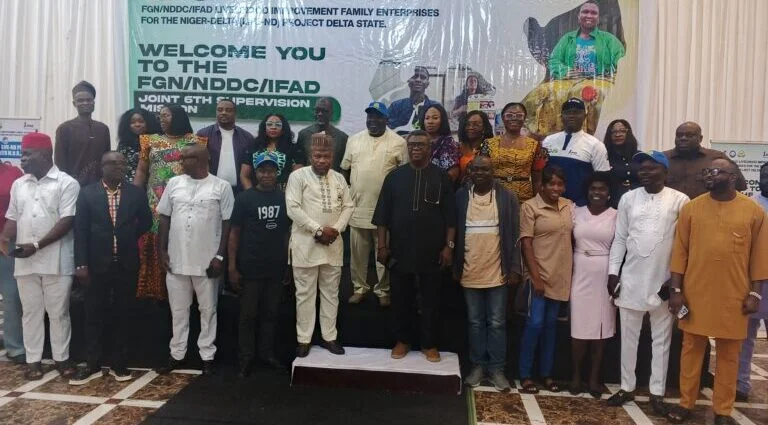
Arenyeka made the assessment in Asaba during a meeting marking the conclusion of the sixth Joint Supervision Mission involving the International Fund for Agricultural Development (IFAD), LIFE-ND and other project stakeholders.
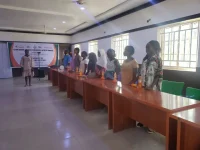
The supervision exercise provided an opportunity for stakeholders to examine the progress of the programme, assess facilities established under the initiative and interact directly with beneficiaries and community leaders.
From training to enterprise
The LIFE-ND model is built around an incubation approach in which experienced agribusiness operators guide new entrepreneurs through practical training and enterprise development.
In Delta, the programme has supported activities across areas including cassava, oil palm processing, poultry, fisheries and vegetable production.
The latest supervision mission took stakeholders to Agbor-Obi and Ekuma communities in Ika South Local Government Area, as well as Emu-Obodeti in Ndokwa West Local Government Area.
At Agbor-Obi, the team inspected greenhouse facilities where beneficiaries were cultivating habanero and bell peppers alongside vegetables such as amaranthus, pumpkin leaf and ewedu.
Innovation taking root
At Ekuma, the team inspected a poultry facility equipped with a five-compartment pen, a biogas-based brooding system and a Black Soldier Fly facility.
The facilities demonstrate the programme’s emphasis on combining agricultural production with technologies aimed at improving efficiency and reducing waste.
The Black Soldier Fly initiative, for instance, forms part of an approach to turning organic waste into useful agricultural inputs, while the biogas system introduces an alternative method of managing poultry-related waste.
Stakeholders also inspected a mini oil-palm processing facility, an open market and lock-up shops at Emu-Obodeti.
Thousands already reached
Delta has recorded significant participation under the programme.
The state government said the first phase of LIFE-ND surpassed its initial target of 4,250 beneficiaries, reaching 4,373 people.
The additional financing phase has set a higher target of 10,805 beneficiaries in the state.
The programme’s wider impact is also reflected in more recent figures. LIFE-ND’s Delta coordinator reported in August that more than 6,000 youths and women had been reached through agribusiness interventions across 10 participating local government areas.
Government plans wider rollout
Arenyeka said the state government intends to sustain the incubation approach and use it to train more young people in agriculture.
The initiative is intended to move beneficiaries beyond basic farming activities towards commercially viable enterprises capable of generating income and employment.
The commissioner also stressed the importance of protecting the institutions and structures established through the programme so that they can continue operating after external project support ends.
These include community-based structures and enterprise groups expected to take greater responsibility for managing facilities, mobilising resources and sustaining the gains recorded under the project.
Call for sustainability
LIFE-ND National Project Coordinator, Abiodun Sanni, said the supervision exercise had provided an opportunity to see the programme’s impact directly and engage beneficiaries, incubators and community leaders.
The project is supported by the Federal Government, participating state governments and the Niger Delta Development Commission, with financing from IFAD.
The Delta Project Coordinator, Collins Ashoro, has also identified additional funding as important to expanding the programme’s reach to more communities.
For Delta, the emerging challenge is therefore no longer simply getting young people into agriculture, but ensuring that enterprises created through the programme remain productive, competitive and sustainable.
With thousands of beneficiaries already reached and additional financing underway, stakeholders say the continued success of the LIFE-ND model will depend on strong local ownership, access to finance, functioning infrastructure and sustained technical support.
The developments in Delta suggest that when agricultural training is connected to practical enterprise development, infrastructure and market-oriented production, farming can become a stronger pathway to jobs, income and rural economic growth.







Leave a comment