


By Benson Daniel
A major rewilding project in northern England is attempting to reshape the way large areas of land are acquired, managed and eventually owned, with its backers promising that the property will ultimately be transferred to community or charitable ownership.
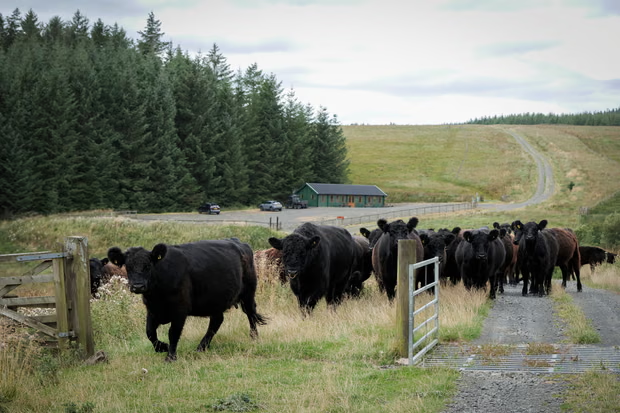
The project centres on Emblehope Moor, a 7,500 acre estate in Northumberland that has been acquired by nature restoration company Restore for £8.5 million.
The vast upland site is being described as part of an emerging landscape of restored and increasingly wild estates in Northumberland, with environmentalist Ben Goldsmith referring to the wider area as “Britain’s Yellowstone”.
Restore’s plan differs from conventional land investment models because it does not intend to retain the estate indefinitely as a private asset. The company wants investors to receive their financial returns, repay the £4.5 million loan that helped finance the purchase and eventually hand the property over to a local community or charitable organisation.
The project is expected to require a further £4 million to fund its 20 year restoration programme.
Restore founder Benedict Macdonald said the model was designed to demonstrate that land investment could generate financial returns while also creating lasting environmental and social benefits.
The organisation plans to restore Emblehope’s damaged peatlands, remove large areas of non native Sitka spruce and improve habitats for a range of wildlife.
The estate already supports species including merlin, golden eagles, red squirrels and pine martens, while its streams contain trout and salmon. The restoration programme aims to create conditions that could support additional species, including curlews, black grouse and beavers.
One of the immediate priorities is restoring water to the moorland. A network of land drains has left sections of peatland unusually dry, reducing its ability to retain water and increasing environmental risks.
Modelling indicates that restoring the peat could allow the land to hold an additional 100,000 cubic metres of water, equivalent to roughly 40 Olympic swimming pools.
Restore also intends to introduce Exmoor ponies to control thick vegetation and reduce fire risks. The grazing is expected to create more varied grassland that can support a wider range of plants and wildlife.
Large areas of Sitka spruce plantations are also scheduled for removal. Restore argues that the dense plantations support relatively little wildlife and can contribute to unnaturally high levels of predation.
The organisation is not, however, planning to transform the estate by simply removing all existing land management practices. The farm and gamekeeping staff are expected to remain because of their knowledge of the landscape and its history.
The project is also being careful about proposals to reintroduce lynx to Northumberland. Although there is local support for the return of the predator, Restore says it has no funded plans to introduce lynx and does not intend to become directly involved in the campaign.
Financing the long term restoration programme will involve several sources of income, including forestry, farming, government environmental payments, education and carefully managed tourism.
However, Restore expects natural capital payments to provide much of the funding. These could include carbon credits generated through restored peatland and corporate sponsorship of habitat restoration.
The wider Northumberland landscape is already seeing growing interest in large scale conservation. Nearby projects include the proposed acquisition of the Rothbury estate by the Wildlife Trusts, while other private estates are pursuing their own nature restoration programmes.
For Restore, the Emblehope project is intended to go beyond rewilding. It is also an experiment in whether private investment can be used to restore landscapes without turning ownership of valuable natural assets into a permanent accumulation of wealth.
If successful, the model could offer a new approach to large scale conservation in Britain, combining commercial investment with environmental restoration and eventual community ownership.










Leave a comment