


By Benson Daniel
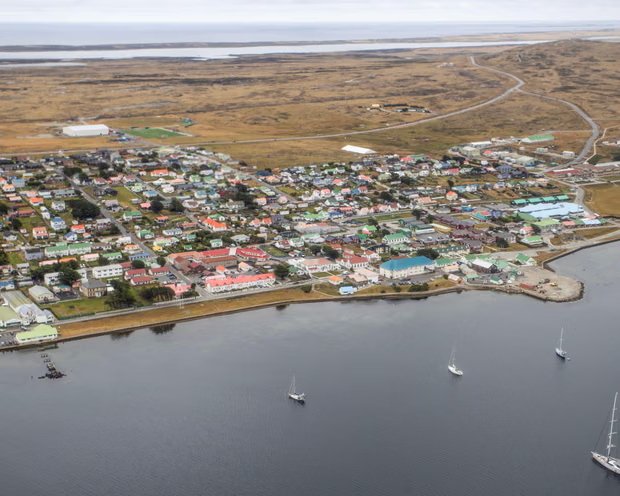
Renewed tensions over the Falkland Islands have intensified calls within the Labour Party for the British government to commit to increasing defence spending to 3 per cent of gross domestic product by 2030.
Tan Dhesi, the Labour MP who chairs the House of Commons Defence Select Committee, said recent comments by Argentine President Javier Milei had demonstrated why Britain could not afford to delay decisions on military funding.
Dhesi urged Prime Minister Andy Burnham and Chancellor John Healey to set out a clear path towards the 3 per cent target rather than defer the decision to a future spending review.
His intervention comes after Milei renewed Argentina’s claim to the Falkland Islands, saying what he described as favourable international circumstances were creating new opportunities for his country’s position on the disputed territory.
The Argentine president’s comments followed remarks by US President Donald Trump that appeared to cast uncertainty over Washington’s longstanding position on the Falklands.
Britain has maintained sovereignty over the islands since the 1982 Falklands War, while Argentina continues to claim them as its territory. The British government has repeatedly stressed that the wishes of Falkland Islanders remain central to its position.
Dhesi said the latest developments should serve as a warning that Britain needs properly funded armed forces capable of responding to emerging threats.
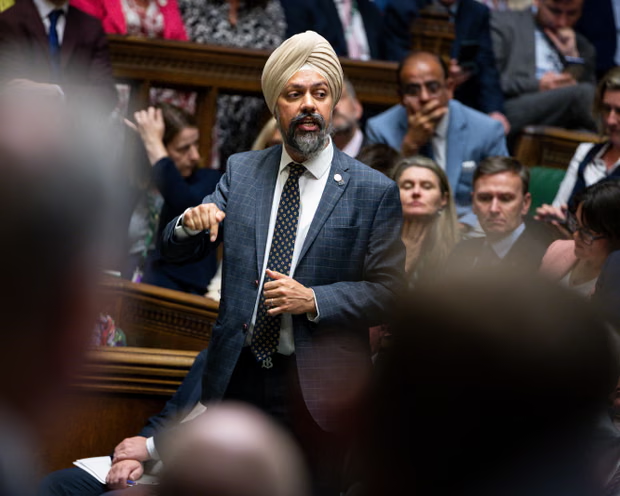
The Labour MP had already challenged Burnham in Parliament over defence spending, asking the prime minister to commit to reaching 3 per cent of GDP by 2030.
Burnham appeared to indicate that he had made such a commitment, but Downing Street subsequently clarified that the prime minister had not made a firm pledge to meet the 2030 target.
That clarification has left the government facing continued questions over its defence plans.
The government has committed to a broader NATO target under which defence and security related spending is expected to rise to 3.5 per cent of GDP by 2035. However, ministers have yet to provide a detailed timetable for reaching 3 per cent by 2030.
The uncertainty has frustrated Dhesi, who argues that Britain’s security requirements demand decisions now rather than promises that could be revisited several years from today.
The pressure comes at a particularly difficult time for the British military. The Army has been forced to suspend a number of non essential training exercises because of budget constraints, while ministers are simultaneously being asked to increase defence spending.
Reaching 3 per cent of GDP would require billions of pounds in additional annual spending, placing further pressure on the Treasury at a time when the government is already dealing with limited fiscal headroom and competing demands from public services.
Healey, who previously served as defence secretary, has been a strong advocate of increased military spending. However, as chancellor, he has indicated that the government will set out the detailed route towards its longer term defence targets during the next spending review.
Dhesi believes waiting could leave Britain less prepared to respond to a rapidly changing international security environment.
The Falklands dispute adds another dimension to the debate because the islands remain a British Overseas Territory and require a permanent defensive posture.
The Ministry of Defence has previously said Britain maintains an appropriate military presence in the Falklands and regularly reviews its posture in response to developments.
For the government, the challenge is now to balance the need for stronger defence capabilities with the financial realities confronting the Treasury.
The renewed dispute over the Falklands has nevertheless given Labour’s internal campaign for greater defence spending fresh momentum, increasing pressure on Burnham to provide a clearer timetable for achieving the 3 per cent target.









Leave a comment