


By Benson Daniel
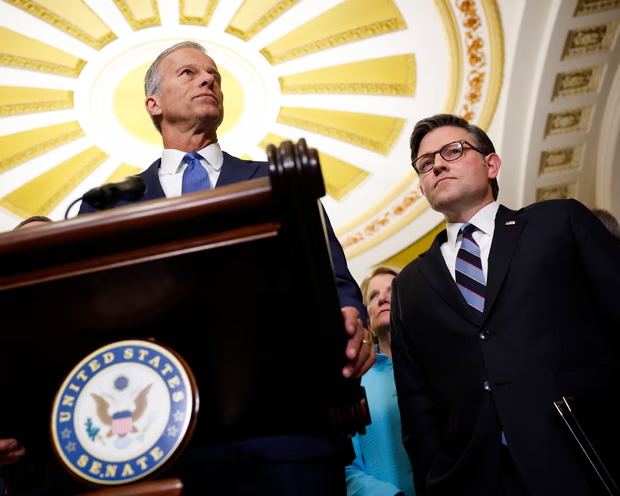
The race for control of the United States Congress is moving into a decisive stage as Republicans and Democrats prepare for a fiercely contested November 3 midterm election that could reshape the balance of power in Washington.
Republicans currently control both the House of Representatives and the Senate, giving President Donald Trump a unified government for the first two years of his second term. But those majorities are under growing pressure as Democrats target vulnerable Republican seats and campaign heavily on the cost of living, economic concerns and opposition to the administration’s policies.
The House is emerging as the most competitive battleground.
Democrats have gained ground in national polling and several election forecasts now give them a strong chance of taking control of the chamber. A forecast from political scientists at Cornell University gives Democrats an 80 per cent chance of winning a House majority, with the model projecting roughly 226 Democratic seats compared with 209 for Republicans.
The forecast is not a prediction of a guaranteed outcome, but it highlights the difficult political environment facing Republicans.
The party’s narrow House majority means Democrats do not need a sweeping national victory to take control. A relatively small number of competitive districts could determine which party chooses the next Speaker and controls the legislative agenda.
The Senate presents a different challenge.
Republicans hold 53 seats, compared with 45 Democrats and two independents who caucus with Democrats. Democrats therefore face a steeper path to securing a majority and must overcome the Republican advantage in several key contests.
Battlegrounds including Georgia, Michigan, Maine, North Carolina, Ohio and Texas are attracting particular attention as both parties pour money and political resources into competitive races.
Texas has become one of the clearest examples of the changing political landscape. Republican Ken Paxton is facing Democrat James Talarico in a race that would previously have been viewed as a relatively safe contest for the Republican Party. Trump’s political operation has already committed millions of dollars to advertising in support of Paxton.
Republicans are also preparing for a major midterm convention in Dallas this week, where Trump and Vice President JD Vance are expected to rally the party’s supporters ahead of the final stretch of the campaign.
Democrats, meanwhile, are seeking to turn voter dissatisfaction with the administration into electoral gains. Recent polling indicates a significant shift in party identification, with more voters currently identifying with or leaning towards Democrats than Republicans.
Economic conditions are likely to be central to the campaign. Democrats are highlighting the cost of living and arguing that Trump’s economic policies have failed to deliver sufficient relief for households, while Republicans are seeking to maintain support by focusing on taxes, immigration, national security and their broader policy agenda.
Redistricting is another major factor. Republican controlled states have pursued new congressional maps designed in some cases to strengthen their position, while Democrats have also fought for favourable boundaries in states where they have influence.
The outcome could have consequences far beyond individual congressional races.
A Democratic takeover of either chamber would make it considerably harder for Trump to push major legislation through Congress. Democrats would also gain greater control over congressional committees and investigations, increasing their ability to scrutinise the administration.
Republicans therefore face the challenge of defending their majorities while maintaining enthusiasm among voters who helped return Trump to the White House in 2024.
For Democrats, the election represents an opportunity to reverse the political losses suffered during Trump’s presidential victory and establish a stronger position heading into the final years of his presidency.
Turnout will be crucial. Midterm elections traditionally attract fewer voters than presidential contests, making the ability of each party to mobilise its supporters particularly important.
With less than two months remaining before voting day, both parties are now treating virtually every competitive district and Senate race as a potential turning point.
The battle for Congress is therefore no longer a distant political contest. Campaigns are accelerating, money is flowing into key states and party leaders are preparing for a final stretch in which relatively small changes in turnout and voter sentiment could determine who controls Washington from January 2027.









Leave a comment