


By Benson Daniel
Travellers heading to the European Union could face longer waits at border crossings after temporary measures allowing countries to ease new biometric checks expired on Sunday.
The flexibility was introduced to help airports and other border points manage heavy passenger volumes while the European Union’s new Entry/Exit System continues to be rolled out.
Under the EES, non EU travellers entering the Schengen area are required to have their passport details and biometric information, including fingerprints and facial images, recorded electronically.
The system is intended to replace traditional passport stamping and provide authorities with a more effective way of monitoring entries, exits and the length of visitors’ stays.
However, its introduction has been accompanied by long queues and technical difficulties at some of Europe’s busiest airports and border crossings.
During the summer, member states were allowed to temporarily suspend biometric checks at individual crossing points when queues became excessive. The measure helped prevent the widespread disruption that had been feared during the peak holiday season.
That flexibility expired on September 6, raising concerns that congestion could return as authorities lose the ability to simply pause the new checks when passenger volumes overwhelm border facilities.
Airlines and travel organisations had urged the European Commission to extend the arrangement until the end of the year, warning that the system was not yet operating smoothly enough to cope with peak demand at every crossing.
The industry argued that the temporary measures had been an important safety valve during the summer and helped prevent passengers from missing flights because of prolonged border processing.
Despite the expiry of the formal flexibility period, the transition is unlikely to be uniform across Europe.
Some countries are reportedly continuing to operate with reduced or incomplete biometric checks because of technical problems or operational difficulties. France, for example, is still experiencing problems with the EES equipment and software used at several crossings serving travellers from the United Kingdom.
At the Channel crossings, fingerprinting equipment installed by Eurotunnel, the Port of Dover and Eurostar at London St Pancras has yet to become fully operational.
This means some travellers crossing between Britain and France may not immediately notice a significant change, although authorities are expected to introduce the full process once the necessary technical approvals are in place.
The situation is also being closely watched by airlines, airports and tourism businesses, which fear that renewed queues could cause flight delays and disrupt connecting journeys.
The EES has already been blamed for significant disruption at several European airports since its introduction, with some passengers reporting lengthy waits at immigration controls.
Travel industry representatives say the problem is not necessarily the biometric system itself but the speed at which the new process can be completed when large numbers of passengers arrive simultaneously.
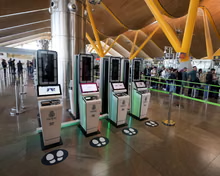
Airports have invested heavily in new kiosks and infrastructure, but technical problems, staffing requirements and differences in implementation between countries have complicated the rollout.
The European Commission has maintained that the system has broadly operated successfully while acknowledging that some member states still require adjustments.
For travellers, the end of the flexibility period means allowing additional time at airports and other external Schengen borders is increasingly important, particularly during busy travel periods.
The EU is continuing to work with member states to address technical and operational problems, but the possibility of renewed queues remains a major concern for the aviation and tourism sectors.
The coming weeks will provide a crucial test of whether Europe’s new digital border system can cope with normal passenger volumes without the emergency measures that helped keep queues under control during the summer.











Leave a comment