


By Dorcas Francis Koji
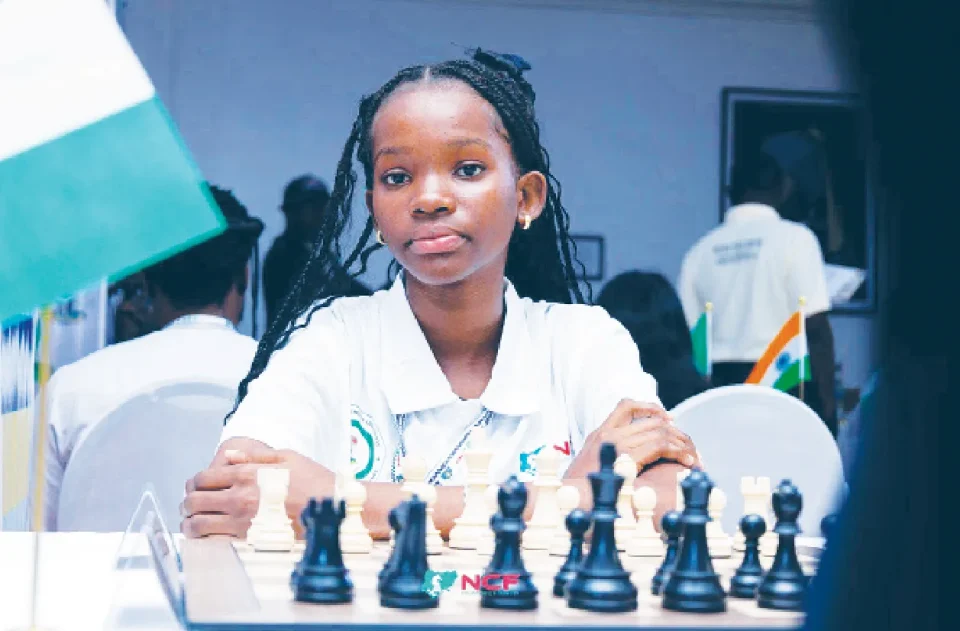
At just 16, Nigerian chess prodigy Sandra Omoruyi is already setting her sights on the highest levels of the game after capturing the World Rapid Amateur Chess Championship in Abuja in August.
The teenager’s victory marked a major milestone in a journey that began in a family where chess is a shared passion and has since been shaped by discipline, sacrifice and an intense commitment to improvement.
Omoruyi was introduced to the game by her father, who also became her first coach, while her siblings helped her learn how to record chess moves.
Her development later continued under her current coach, Edward Eguavoe Evbuomwan, popularly known as Coach Eddy, alongside several other coaches who contributed to her growth.
“I come from a chess family where my dad, mum and siblings all play chess, so my dad was my first coach,” Omoruyi said.
She recalled that winning the Most Valuable Player award at the last Youth Games changed her perception of what she could achieve in chess.
“I was initially just playing to learn and enjoy the game. After the event, I started thinking, ‘Maybe I can actually do this at the highest level.’ That moment gave me the confidence to take chess more seriously and aim for bigger titles like the World Amateur Championship.”
However, her rise has not been without challenges.
Omoruyi said financial constraints, travelling long distances to competitions and security concerns have sometimes prevented her from attending tournaments, particularly because she is still a minor.
Her first major competition was the National Chess Championship, an experience she initially approached with fear but one that ultimately convinced her that she could compete at a higher level.
“At first, I was scared, but after the event, I realised that I could actually do it, even though it was hard,” she said.
Her commitment to improvement has also demanded an extraordinary training schedule.
According to Omoruyi, her preparation can stretch from 10 to 16 hours a day, depending on the demands of her programme.
On less demanding days, training begins around 9am or 10am and can continue until 10pm or 11pm, with breaks for meals and school-related activities.
During more intensive periods, particularly while preparing for the Chess Olympiad, her sessions have sometimes extended until 2am or 3am as she played practice games against chess engines.
She credits her coach with designing a demanding routine that covers different aspects of the game according to the day’s objectives.
Despite the workload, Omoruyi said careful planning and discipline help her maintain a balance between chess, education and family.
“It’s all about planning and discipline. School and family come first. I use evenings and weekends for chess training. My family is very supportive, and they help me stay focused,” she said.
Her World Rapid Amateur Championship victory in Abuja was the product of weeks of specialised preparation.
Omoruyi worked with Coach Eddy on Rapid and Blitz-specific exercises, including tactical puzzles and practice games against his students, particularly his son, Henry Evbuomwan.
The sessions were designed to prepare her for the speed and pressure associated with the formats.
But her biggest test came during the Blitz competition, when she suffered three consecutive defeats at the beginning of the event.
“I was down. I started asking myself, ‘Is this really happening? Did I travel all this way to lose?’” she recalled.
A conversation with her coach helped her regain focus. He encouraged her to step away, take a few deep breaths and clear her mind.
Omoruyi then reminded herself that the tournament was far from over and decided to approach each remaining game individually.
The change in mindset sparked a remarkable turnaround as she began winning again.
“That comeback showed me that resilience is everything in chess. You can have a bad start, but you don’t have to finish badly,” she said.
Winning the title brought a mixture of disbelief, joy and relief.
“When I realised I had won, the first thing I did was look up and thank God,” Omoruyi said, while also remembering her family, coach and everyone who supported her journey.
For the teenager, the title represented more than a trophy. It was a reward for the early mornings, defeats and sacrifices that had accompanied her development.
“Most of all, I felt so proud to raise the Nigerian flag and bring the title home,” she said.
The triumph has also changed her perception of her own ability ahead of the Chess Olympiad.
Omoruyi now believes she can compete successfully on the world stage and has set her sights on achieving title norms before eventually becoming a Grandmaster.
“In the short term, I want to achieve title norms. In the long term, I want to become a Grandmaster and help Nigeria win at the Olympiad. I believe this is just the beginning,” she said.
Her ambitions, however, extend beyond the chessboard.
While pursuing Grandmaster status and representing Nigeria and Africa internationally, Omoruyi also dreams of becoming a medical doctor.
She hopes to use her future career to help others and give back to her community, while encouraging more young girls to take up chess.
“I want them to see that it doesn’t matter where you start — from the streets, from school or from anywhere. You can get to the top,” she said.
“With God, hard work and resilience, I believe I can achieve both my dreams in chess and in medicine. I’m not done yet. This is just the beginning.”








Leave a comment