



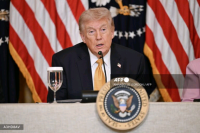
U.S. President Donald Trump said negotiations with Iran will resume on Monday, but declined to set a deadline for reaching an agreement, after earlier indicating he had postponed a planned military strike in hopes of securing a diplomatic breakthrough over the Strait of Hormuz and Tehran’s nuclear programme.
Trump said discussions with Iran would begin on Monday afternoon, although he did not disclose the location of the talks or identify the officials expected to participate. He also declined to specify how long negotiations would be allowed to continue before considering other options.
Speaking to reporters upon returning to Washington from New Jersey, Trump said he preferred a diplomatic solution to further military action.
“Would I rather make a deal? I’m not looking to kill people because people die, a lot of people die, and we don’t want that,” Trump said.
The comments followed a statement Trump posted on his Truth Social platform late Saturday, saying Iran and other Middle Eastern countries had requested additional time to finalise an agreement that would result in the “immediate, complete and total” reopening of the Strait of Hormuz and address what he described as Iran’s nuclear threat. He added that Tehran must “rapidly make a DEAL.”
Trump has repeatedly threatened to escalate military operations against Iran since the conflict involving the United States and Israel intensified in late February. However, he has also periodically delayed further strikes to allow diplomatic efforts to continue, though previous negotiations have yet to produce a comprehensive agreement.
The conflict has expanded beyond the Gulf, affecting shipping routes through the Red Sea and even reaching facilities in the eastern Mediterranean. Iran has largely restricted traffic through the Strait of Hormuz, a strategic waterway that normally carries about 20 per cent of global oil and liquefied natural gas exports, contributing to higher global energy prices and renewed inflation concerns.
Oil prices fell by more than four per cent in early trading on Monday amid optimism that renewed negotiations could reduce tensions in the region. Trump has argued that preventing Iran from acquiring nuclear weapons justifies temporary increases in fuel prices, although rising energy costs have increased domestic political pressure on his administration to seek a diplomatic resolution.
Meanwhile, Iran continued diplomatic engagement with regional partners. Iranian state media reported that Foreign Minister Abbas Araqchi held separate discussions with Saudi Foreign Minister Prince Faisal bin Farhan and Pakistan’s Army Chief Asim Munir regarding ongoing diplomatic initiatives.
Iran’s official news agency IRNA also reported that negotiations between Tehran and Oman over arrangements concerning the Strait of Hormuz were in their final stages. However, Foreign Ministry spokesperson Esmaeil Baghaei said the discussions focused on establishing an alternative maritime route and were unrelated to the question of whether the strait would remain open or closed.
Last month, Iran publicly rejected an Omani proposal, supported by several Gulf states, that sought to introduce a voluntary fee system for ships using the strategic waterway.
In Israel, Energy Minister Eli Cohen, a member of Prime Minister Benjamin Netanyahu’s security cabinet, said Israel remained in close coordination with the United States on regional security matters. He warned that Israel would continue to act independently if Iran resumed work on its nuclear programme or expanded its ballistic missile capabilities.
“With or without an agreement, and regardless of any external commitments, if Iran attempts to renew its nuclear program or advance its ballistic missile industries, we will be there. We will take action, and we will strike,” Cohen said.
Trump and Netanyahu met in Washington last week, where officials said they discussed diplomatic, economic and military options for preventing Iran from developing nuclear weapons. Tehran continues to deny that its nuclear programme is intended for military purposes.






Leave a comment