


By Benson Daniel
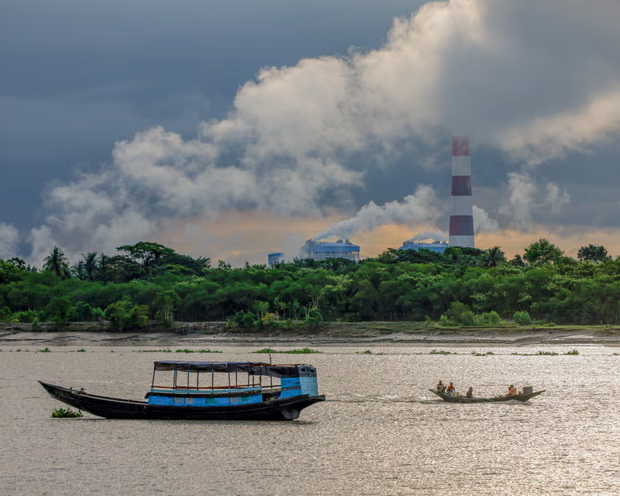
Barclays is facing a formal complaint over its financial links to a coal fired power plant located near the Sundarbans, the world’s largest mangrove forest and a UNESCO World Heritage site.
Three complainants from Bangladesh and India have filed the case with the UK government’s Office for Responsible Business Conduct, alleging that the British bank failed to carry out adequate environmental and human rights checks before supporting companies connected to the Maitree super thermal power project, also known as the Rampal power plant.
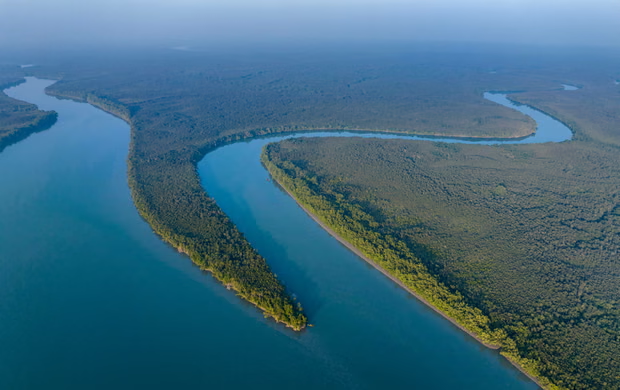
The plant sits on the bank of the Pasur River, an important waterway running through the Sundarbans. The vast mangrove ecosystem stretches across Bangladesh and India and supports millions of people who depend on its rivers, forests and fisheries for their livelihoods.
The complainants include an environmental campaigner, a farmer and politician, and a trade union representing fish workers in West Bengal. They are being assisted by lawyers and students from King’s College London’s Human Rights and Environment Clinic.
At the centre of the complaint is Barclays’ involvement in financing linked to the project.
The bank underwrote debt for India’s state owned NTPC, one of the partners behind the power station. It also underwrote bond issues for the Export Import Bank of India between 2016 and 2019, which provided financing for the Rampal project.
The complainants argue that Barclays should have considered the potential consequences of the plant’s emissions and other industrial activities on the fragile ecosystem before providing financial services.
Their concerns have been reinforced by scientific findings on pollution in the area. A study published last year detected elevated concentrations of mercury and arsenic in water samples from the Sundarbans, with the highest levels recorded in the Pasur River.
Researchers identified industrial discharge and port activity among the potential sources of contamination and warned that the power plant could pose a significant environmental threat because of coal emissions and increased shipping activity.
The Sundarbans is particularly vulnerable because its mangrove forests provide a natural defence against cyclones, rising seas and other extreme weather events. Damage to the ecosystem could therefore have consequences far beyond biodiversity.
The Rampal project has faced environmental opposition since its development. UNESCO previously warned that pollution from the plant could cause serious and potentially irreversible damage to the World Heritage property.
Some international financial institutions declined to support the project because of concerns over its environmental and social impact.
The latest complaint has revived questions about the responsibility of international banks when financing projects in environmentally sensitive areas.
Campaigners argue that financial institutions should be required to conduct deeper assessments of the environmental and social consequences of projects before providing funding, particularly when those projects are located close to protected ecosystems.
They are also calling for greater investment in renewable energy, arguing that Bangladesh has significant potential for solar power and should reduce its dependence on imported fossil fuels.
The Office for Responsible Business Conduct will now assess whether the complaint should proceed.
Barclays and the company responsible for the Rampal project have declined to comment on the allegations.
The case could add to the growing pressure on major banks to demonstrate that their financing decisions are consistent with their climate and sustainability commitments, particularly as governments and investors increasingly scrutinise the environmental impact of fossil fuel projects.






Leave a comment