



The Managing Director of the International Monetary Fund (IMF), Kristalina Georgieva, has warned that the risks associated with artificial intelligence (AI) could outweigh its potential benefits without adequate safeguards and an ethical framework.
Speaking on Friday at the 2026 IMF and World Bank Annual Meetings in Bangkok, Thailand, Georgieva said AI was already strengthening the global economy but cautioned that the technology could also trigger economic shocks if expected productivity gains failed to materialise.
She called for a combination of industry self-regulation, government engagement and public participation to establish appropriate safeguards for the rapidly evolving technology.
“If there are no safeguards, then the risks may exceed the opportunities,” Georgieva said, emphasising the need for an ethical foundation to guide AI development and deployment.
AI Growth Raises Economic and Financial Concerns
The growing investment in AI infrastructure has raised concerns about employment, financial stability and the sustainability of the technology boom.
Bundesbank President Joachim Nagel warned that the substantial investments required for AI hardware and software could contribute to widening global economic imbalances.
Harvard economist Dani Rodrik also highlighted two possible risks. If AI delivers the productivity gains investors expect, businesses could still face significant job displacement. However, if those gains fail to materialise, heavy investment in data centres could trigger a costly financial market correction.
Rodrik said the global economy could face either an employment crisis or a financial crisis, depending on how AI adoption unfolds.
Anthropic Co-Founder Calls for Common Standards
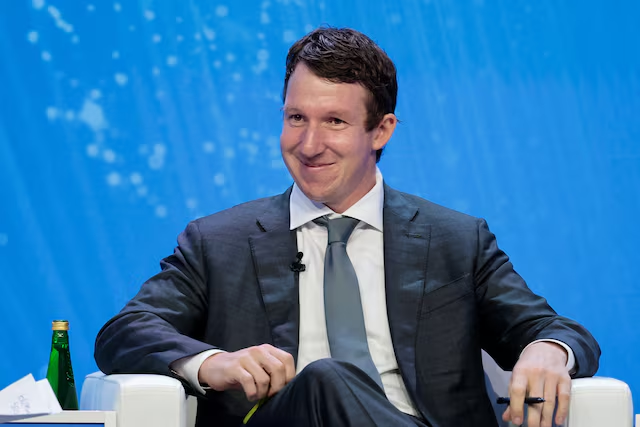
Anthropic co-founder Jack Clark supported the establishment of common-sense standards to improve AI safety and public confidence.
Clark said technology companies could contribute by regularly testing their systems and publishing information about the results. However, he argued that AI safety should not depend entirely on voluntary commitments.
He pointed to early policy frameworks in the European Union and voluntary industry commitments in the United States as examples of efforts to establish safeguards.
Georgieva also stressed that countries with major AI industries, including the United States, China and India, should participate in developing appropriate standards, alongside countries involved in the AI supply chain.
Infrastructure and Regulation Remain Essential
Beyond safety and regulation, Georgieva said widespread access to AI would depend on reliable electricity, digital infrastructure and suitable regulatory frameworks.
These conditions are important to ensure that the benefits of AI reach people and businesses across different economies, rather than remaining concentrated in countries and companies with the greatest technological resources.
Meanwhile, US Treasury Undersecretary Erin Browne argued that greater attention should be given to AI’s potential economic opportunities, rather than focusing predominantly on the risks. She said the technology could generate positive economic shocks if it delivers substantial productivity improvements.
The debate reflects differing views among policymakers and industry leaders about how to balance AI’s economic potential with the need to manage its consequences.
The Road Ahead for Artificial Intelligence
As governments and technology companies accelerate AI development, establishing effective safeguards, transparent testing standards and an ethical framework is becoming an increasingly important global policy issue.
The challenge is to encourage innovation and productivity while reducing the risks of job displacement, financial instability and unequal access to technological benefits.
Georgieva’s warning highlights the importance of preparing for both the opportunities and the potential disruptions that AI could bring to the global economy.










Leave a comment