


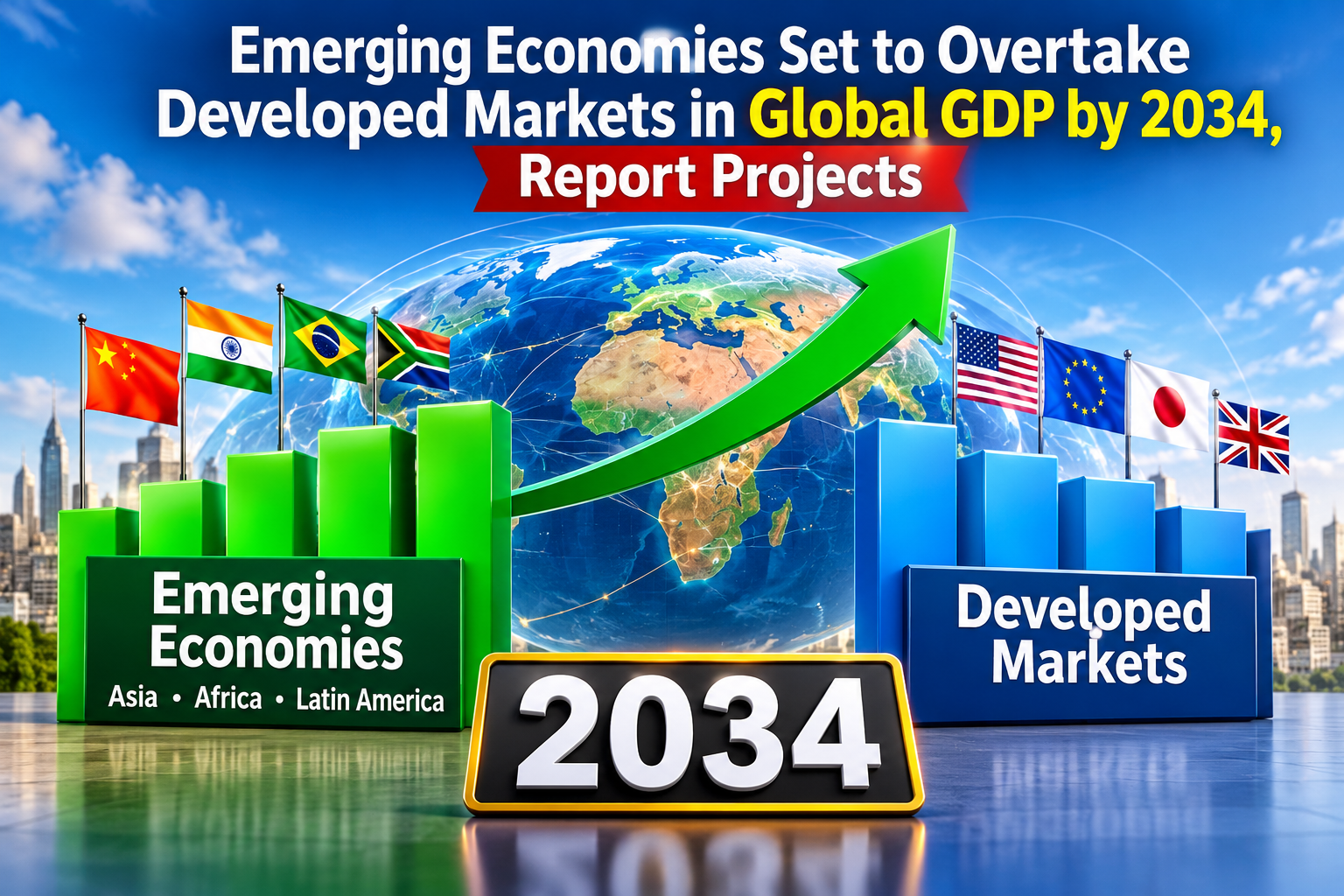
Emerging economies are projected to account for more than half of global economic output by 2034, marking a major shift in the distribution of global economic power from advanced economies towards developing markets, particularly in Asia.
The projection comes from a long-term economic assessment published by BRICS+ Thinking, which estimates that emerging economies will increase their share of global gross domestic product (GDP) from 39% currently to 53% by 2050.
The report expects the emerging-market share to cross the 50% threshold in 2034, reflecting anticipated improvements in productivity, investment, demographics and currency values.
The forecast suggests that countries traditionally regarded as developing economies will play a much larger role in determining global production, trade and investment patterns over the coming decades.
BRICS+ Share of Global Economy Expected to Expand
The BRICS+ group, which includes Brazil, Russia, India, China and South Africa alongside newer members, is also expected to increase its contribution to global economic output.
According to the projections, the group’s share of global GDP will rise from approximately 28% currently to 40% by 2050.
The expansion reflects the growing economic importance of large emerging markets, particularly those in Asia, where population growth, industrial investment and productivity improvements are expected to support long-term economic expansion.
The changing distribution of global output could also increase the influence of emerging economies in international trade negotiations, financial markets and discussions about global economic governance.
Jim O’Neill, a co-author of the report and former Goldman Sachs economist who coined the BRIC acronym, said the projected shift would require policymakers to develop a more open understanding of countries whose economic influence is expanding.
He noted that many policymakers built their economic and political experience in a period when advanced economies dominated global output.
India Expected to Become a Major Economic Power
India is projected to be among the biggest beneficiaries of the anticipated shift.
The report estimates that the country’s economy could reach $19.5 trillion by 2050, approximately 5.5 times its current size.
Its projected expansion reflects expectations of sustained investment, demographic advantages and improvements in economic productivity.
Indonesia and Mexico are also expected to enter the world’s ten largest economies by 2050.
Their projected rise would reflect the increasing importance of emerging markets beyond the traditional economic centres of North America and Europe.
Meanwhile, Italy is expected to drop out of the world’s ten largest economies, while Germany is projected to move from third to fourth position.
These projections indicate that the composition of the world’s largest economies could change considerably over the next 24 years.
Currency Strength and Productivity Will Determine the Outcome
Although the projections point to a substantial expansion of emerging economies, the expected shift depends on several long-term economic assumptions.
The report identifies narrowing productivity gaps between developing and advanced economies as one of the factors supporting the projected change.
It also assumes that emerging-market currencies will appreciate in real terms as their economies become wealthier.
This assumption is important because the projections measure economic output in real 2021 US dollars using market exchange rates.
Consequently, the projected increase in emerging economies’ share of global GDP will depend not only on domestic production growth but also on how their currencies perform against the US dollar.
The report’s near-term growth assumptions are broadly aligned with those of the International Monetary Fund (IMF), but its longer-term projections place greater emphasis on demographic changes, investment and productivity trends.
The 2034 projection should therefore be understood as a long-term economic forecast rather than a guaranteed outcome.
What the Shift Could Mean for Developing Economies
The projected expansion of emerging markets could reshape international investment, manufacturing, trade and financial relationships.
For developing countries, the changing economic landscape could create opportunities to attract investment, participate in regional supply chains and expand exports to markets experiencing stronger growth.
However, a larger share of global GDP does not automatically translate into higher household incomes, improved living standards or stronger public institutions.
Countries must still address infrastructure shortages, productivity constraints, unemployment, weak industrial capacity and financial instability to convert economic growth into broader prosperity.
For Nigeria, the projections offer an important perspective on the country’s position within the changing global economy.
Africa’s largest population and substantial natural resources provide opportunities to participate in expanding emerging-market trade and investment networks. However, realising those opportunities will depend on improvements in domestic productivity, infrastructure, manufacturing capacity and economic stability.
The broader message from the projections is that global economic influence is becoming more distributed. Whether individual emerging economies benefit from that transition will depend largely on their ability to strengthen productive capacity and compete in international markets.








Leave a comment