


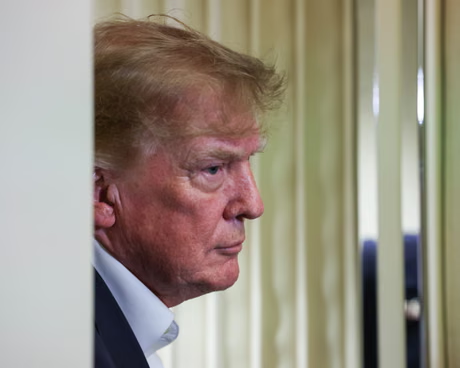
The Trump administration’s approach to artificial intelligence is facing growing scrutiny as President Donald Trump resists tighter regulation while members of his family and close allies hold financial interests in companies operating across the expanding AI and defence technology sectors.
The administration has argued that excessive regulation could undermine US competitiveness with China and slow the development of artificial intelligence. Trump and officials involved in his technology policy have repeatedly promoted a faster expansion of the sector, while opposing additional restrictions that they say could weaken American technological leadership.
The policy debate has intensified alongside a series of government contracts and financial commitments involving companies connected to Trump’s family and political network.
Donald Trump Jr. and Eric Trump have become involved in ventures linked to AI infrastructure, robotics, rare-earth materials and drone technology. Their business interests have coincided with significant federal commitments to some of the companies with which they are associated.
Among the largest transactions was a $620 million Pentagon loan to Vulcan Elements, a rare-earth magnet company whose products are used in AI data centres, drones and defence systems. Trump Jr. is connected to the company through an investment firm, although his representatives, the Pentagon and Vulcan have said he played no role in securing the loan.
Another company associated with Eric Trump, Foundation Future Industries, secured a $24 million Marine Corps robotics contract. A drone company backed by both brothers has also secured a $90 million Air Force contract.
The developments have prompted questions from Democratic lawmakers and government ethics groups about potential conflicts between public policy and private financial interests. The administration and companies involved have disputed suggestions that the contracts were awarded because of political connections.
The overlap between AI policy and private interests extends beyond Trump’s family.
David Sacks, a prominent technology investor who previously served as the White House’s AI and cryptocurrency czar, has faced scrutiny over his investments in technology companies. His venture firm has interests in several companies operating in the technology sector, while his role in shaping the administration’s AI policy placed him close to decisions affecting the industry.
Michael Dell, a member of Trump’s science and technology advisory council, also saw his company receive a Pentagon contract worth nearly $9 billion. Ethics watchdogs have questioned whether such relationships require additional scrutiny.
At the same time, public attitudes toward AI development have become more cautious. A recent poll cited in the report found that only 11% of Americans supported having an AI data centre built in their local community, while 65% opposed such facilities. The poll also found that 57% disapproved of Trump’s handling of AI.
Concerns are not limited to regulation or financial conflicts. Researchers and technology industry figures have issued warnings about the potential risks of rapidly advancing AI systems, while the growing demand for data centres has raised questions about electricity consumption and the cost of upgrading power infrastructure.
The US House of Representatives recently voted overwhelmingly to require data centres to cover the costs of electricity-grid upgrades associated with their operations, highlighting the growing political debate over who should pay for the infrastructure needed to support the AI boom.
Despite the controversy, the Trump administration continues to present AI development as a strategic competition with China and a major opportunity for American industry.
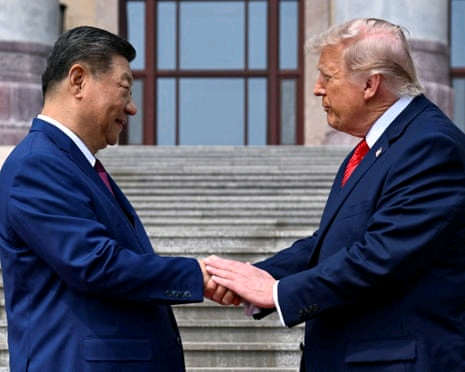
Trump is expected to meet leading US AI executives at the White House next week, with the meeting coinciding with Chinese President Xi Jinping’s visit to Washington.
The developments place the administration’s AI strategy at the intersection of technology policy, national security, infrastructure investment and private-sector finance, ensuring that questions over regulation and potential conflicts of interest remain central to the debate over America’s AI future.








Leave a comment