


By Benson Daniel
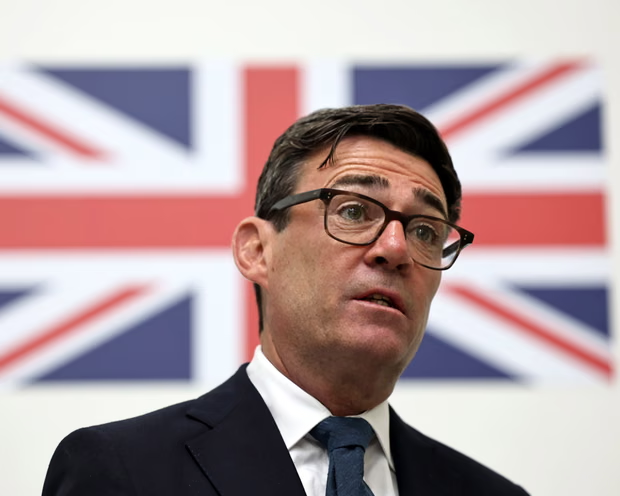
UK Prime Minister Andy Burnham has reaffirmed his commitment to taking the country to net-zero greenhouse gas emissions by 2050, arguing that the effects of climate change are already being felt across Britain.
Burnham said the government must remain fully committed to the target while setting out plans to expand community involvement in renewable energy. His comments come after a summer marked by heatwaves, drought and wildfires, which have intensified debate over the country’s response to climate change.
The prime minister has linked the net-zero transition to a broader programme of local economic development. Under plans announced by the government, communities will receive funding to develop renewable energy projects involving technologies such as solar, wind and hydropower.
The government has announced £30 million for so-called People’s Power projects, designed to give communities a greater stake in local clean-energy schemes. The funding forms part of a wider £1 billion Great British Energy programme intended to support more than 1,000 community energy projects.
Burnham has argued that allowing communities to participate directly in energy generation could help keep more of the economic benefits of renewable energy within local areas. He has also connected the transition to clean energy with industrial development, describing it as an opportunity to rebuild Britain’s manufacturing base and create new economic activity.
The renewed commitment comes amid growing political debate over the UK’s climate strategy. A parliamentary committee has recently argued that the term “net zero” has become politically divisive and recommended changes to how the government communicates its climate policies. The government has nevertheless maintained its commitment to the 2050 objective.
Burnham is also facing difficult decisions over Britain’s future energy mix. Questions surrounding proposed North Sea oil and gas developments have created tension between the government’s climate ambitions and arguments for maintaining domestic fossil-fuel production.
The debate reflects a wider challenge for the UK: reducing emissions while ensuring that households and businesses have access to reliable and affordable energy. Government policy is increasingly focused on expanding renewable generation, improving energy security and encouraging investment in new technologies.
The country’s 2050 net-zero objective remains legally established under the UK’s climate legislation. Meeting it will require major changes across electricity generation, transport, buildings, industry and other parts of the economy.
Burnham’s latest intervention therefore places climate policy at the centre of his government’s wider economic agenda. His administration is seeking to present the transition not only as an environmental obligation but also as a means of supporting local investment, energy development and industrial renewal.
The coming years will determine how effectively those ambitions can be translated into projects that deliver lower emissions while addressing the economic and practical concerns surrounding the transition.










Leave a comment