


By Benson Daniel
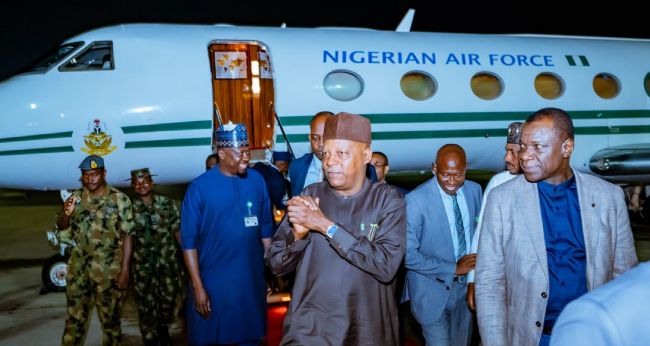
Vice President Kashim Shettima has returned to Nigeria after representing President Bola Tinubu at the 18th BRICS Leaders’ Summit held in New Delhi, India.
Shettima arrived at the presidential wing of the Nnamdi Azikiwe International Airport in Abuja in the early hours of Tuesday after attending the two-day summit, which brought together leaders and representatives of major emerging economies.
Nigeria, which became a BRICS partner country in January 2025, used the summit to strengthen its engagement with the bloc and advance the country’s interests in trade, investment, technology, energy and other areas of economic cooperation.
During the summit, Shettima delivered President Tinubu’s message on the need for reforms to global governance and international financial institutions. He also presented Nigeria as an important gateway to Africa’s expanding market, particularly through the African Continental Free Trade Area.
The Vice President’s participation came as BRICS members continued discussions on strengthening economic cooperation among emerging economies and increasing the influence of developing countries in global decision-making.
The New Delhi summit also focused on issues including international trade, investment, financial cooperation, artificial intelligence, energy, food security and climate change.
Shettima held bilateral engagements on the sidelines of the summit, including a meeting with World Trade Organisation Director-General Ngozi Okonjo-Iweala. Discussions centred on multilateral cooperation and the need for a more inclusive global economic system.
He also met Indian Prime Minister Narendra Modi, with both sides highlighting the importance of strengthening relations between Nigeria and India.
The engagement comes as Nigeria seeks to expand economic ties with India, particularly in trade, investment, technology and other areas where both countries have significant interests.
The summit adopted a joint declaration that called for stronger cooperation among BRICS countries, including greater use of local currencies in trade and improvements in cross-border payment systems.
The gathering also addressed geopolitical tensions and conflicts affecting global stability, while member countries pushed for greater representation of developing nations in international institutions.
Nigeria’s participation is significant because its BRICS partnership provides an additional platform for the country to engage major emerging economies and seek greater access to investment, technology and markets.
Shettima’s return to Abuja marks the end of Nigeria’s official participation in the summit, with attention now expected to shift towards translating the diplomatic and economic discussions into concrete opportunities for the country.
For Nigeria, the broader objective remains the use of international partnerships to attract investment, expand trade and strengthen its position within the global economy.


Leave a comment