


By Benson Daniel
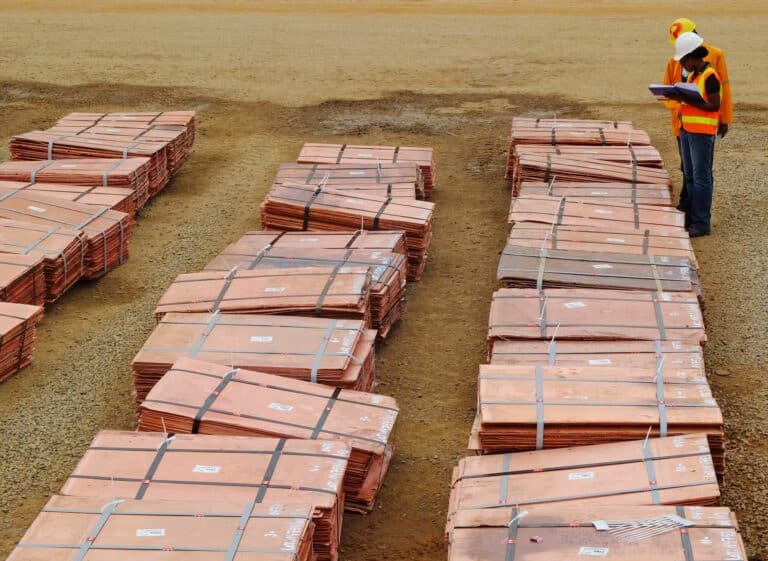
The Democratic Republic of Congo recorded its highest-ever first-half copper exports in 2026 as the country significantly increased sales to the United States and Europe amid efforts to diversify its critical-minerals trade away from China.
Copper exports reached 1.72 million metric tonnes between January and June, compared with 1.65 million tonnes during the same period in 2025, according to first-half mining statistics. At the same time, the share of Congolese copper sales going to the United States and Europe doubled from the previous year.
The development marks an important shift in Congo’s position in the global copper market as major economies compete for reliable supplies of minerals considered essential to manufacturing, electricity infrastructure, electric vehicles and other advanced technologies.
China has traditionally played a dominant role in Congo’s mining industry, with Chinese companies holding major positions in several copper and cobalt operations. The latest export figures, however, indicate that the Congolese government is increasingly seeking alternative markets and stronger commercial links with Western economies.
The change follows a strategic minerals partnership between Congo and the United States signed in December 2025. The agreement has been followed by efforts to expand Western investment and create new routes for Congolese minerals to reach international buyers.
State-owned mining company Gecamines has also been working with international commodity traders, including Mercuria and Glencore, to market its share of copper production from major mining operations to alternative destinations.
The strategy is aimed at reducing Congo’s dependence on a single major trading partner while increasing the value and reach of its mineral resources in international markets.
The United States has been seeking to strengthen access to critical minerals as governments and industries around the world compete to secure supplies needed for energy transition technologies, electricity grids and high-tech manufacturing.
Congo is particularly important to that effort because it is the world’s largest cobalt producer and one of the world’s leading copper producers. The country’s mineral wealth has consequently become increasingly important in the global competition over critical-mineral supply chains.
The export figures also come as Congo tightens controls over the trade in unprocessed minerals. The government banned exports of copper and cobalt concentrates in June, although first-half shipments of copper concentrate still amounted to 151,202 tonnes, containing about 50,629 tonnes of copper.
Cobalt exports, meanwhile, declined by 6.4% in the first half of the year to 41,140 tonnes from 43,930 tonnes a year earlier, reflecting export quotas imposed by the government.
For Congo, greater access to US and European markets could provide new opportunities to attract investment, strengthen export earnings and gain greater influence over how its mineral resources are marketed.
The shift is also significant for global commodity markets because copper is increasingly regarded as a strategic resource. Rising demand from electrification, power infrastructure and advanced technology is expected to keep major producing countries at the centre of international competition for mineral supplies.
Congo’s latest figures therefore represent more than an increase in mining exports. They point to a broader attempt by one of Africa’s most resource-rich economies to reshape its trading relationships and secure a larger role in the global critical-minerals economy.









Leave a comment