



By Benson Daniel
Foreign nationals, particularly African immigrants running small businesses, are increasingly becoming targets of extortion gangs in South Africa as a growing criminal economy intersects with renewed anti-immigrant tensions across the country.
The development has raised fresh concerns over the safety of Nigerians and other foreign nationals living and doing business in South Africa, where extortion has spread across sectors ranging from construction and nightclubs to small convenience stores.
A recent case in Cape Town has highlighted the growing threat. A South African man and his two sons, including a police officer, appeared before a magistrate accused of extorting about 50 convenience stores operated by Ethiopian and Somali nationals. A Somali national was also accused of collecting so-called protection fees from shop owners near Stellenbosch.

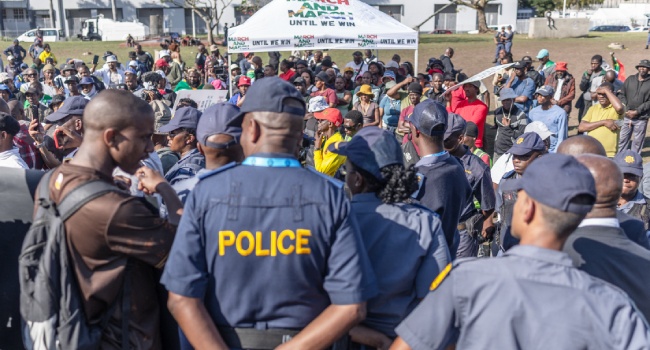
The nationwide protests cap weeks of demonstrations called by a loose coalition of minor political parties and small citizen-led vigilante groups, which set an unofficial June 30 deadline for foreigners without residency papers to leave. (Photo by RAJESH JANTILAL / AFP)
Community leaders say foreign-owned businesses are particularly vulnerable because their operators may be reluctant to seek help from authorities for fear of retaliation or their immigration status being questioned.
Fransina Lukas, head of a community policing forum in the Western Cape, said foreigners were often considered easier targets because they were more afraid to resist criminal gangs.
Extortion groups typically demand regular payments in exchange for supposed protection. Business owners who refuse may face harassment, robbery and, in more serious cases, attacks that can result in death.
The problem has also affected local residents, but Somali-run spaza shops have emerged as particular targets in parts of Cape Town. Community leaders said some extortionists reportedly demand access to business records, including bank statements, to determine how much money they believe a business can afford to pay.
Fear of retaliation has contributed to significant underreporting, while allegations that some criminals receive information from corrupt officials have further weakened victims’ confidence in the police.
The threat extends beyond commercial shops. A Cape Town Islamic school and mosque was reportedly approached by men demanding an initial registration payment of 3,000 rand, followed by monthly payments. The institution later reported the incident to the police.
Organised crime investigators have linked the expansion of extortion to growing frustration with lengthy civil court processes, with some individuals turning to criminal groups to settle commercial and personal disputes outside the legal system.
The Western Cape has recorded a particularly high level of the problem. Police statistics showed the province accounted for nearly half of 112 protection-racket extortion cases recorded nationally between April and June, while 30 of the 76 murders recorded at spaza shops during the period occurred in the province.
The situation is unfolding against a broader backdrop of xenophobic tensions. Foreign-owned shops were among businesses targeted during protests earlier this year, when groups demanded that undocumented migrants leave South Africa. Some businesses were looted, set on fire or forced to close.
The violence has also taken a heavy toll on Nigerians. Nigeria’s Minister of State for Foreign Affairs, Ambassador Sola Enikanolaiye, said at least 98 Nigerians had died in mob attacks, hate-related violence and extrajudicial killings in South Africa since 2022.
Nigeria has also evacuated more than 1,600 citizens from South Africa this year amid security concerns and renewed threats against foreigners. The Nigerian diplomatic mission has continued preparations for further evacuations as anti-immigrant groups maintain pressure on foreign nationals to leave.
The escalating crisis has strained relations between Nigeria and South Africa, with Nigeria’s National Assembly recently suspending official visits and legislative engagements with South Africa over attacks on Nigerians and other African migrants.
South African authorities have acknowledged that extortion has grown sharply in recent years, but officials have also admitted that tackling the expanding criminal networks remains a major challenge.
For foreign business owners, the combination of extortion, gang violence and xenophobic hostility has created an increasingly difficult environment, raising questions about how effectively authorities can protect businesses and residents regardless of nationality.











Leave a comment