



By Benson Daniel
Nepal has begun a major DNA identification effort as authorities struggle to identify hundreds of people killed or reported missing in the devastating floods that have swept parts of the country.
More than 1,000 deaths have been confirmed, while nearly 4,000 people remain missing, leaving families desperate for information about relatives who were separated from them during the disaster.
Among those waiting for answers is 19 year old Prakrit Gurung, who has provided a blood sample in the hope that her DNA can be matched with the body of her missing mother.
Gurung has already lost her father. Her family was able to identify his body after her brother recognised his photograph displayed outside a hospital.
Her mother, however, remains missing.
Gurung was among dozens of relatives who lined up at a hospital in Kathmandu to provide blood samples as part of the government’s effort to identify victims whose bodies have been recovered.
Authorities are also asking relatives living abroad to provide DNA profiles where necessary, particularly when families have members missing in the disaster.
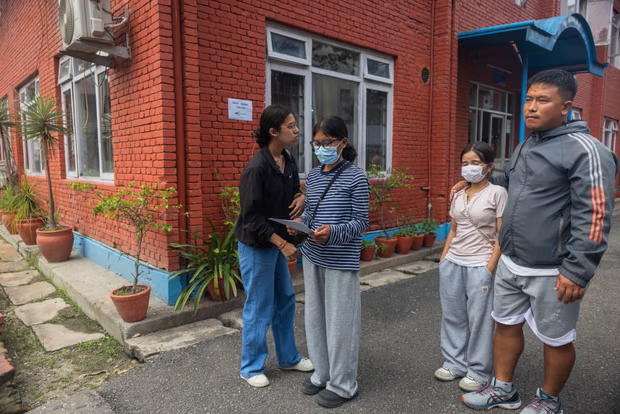
The identification programme is being organised as morgues struggle to cope with the number of bodies recovered from flood affected communities. Some bodies have had to be buried because there is not enough space to keep them in morgues while identification efforts continue.
Army officials collecting the samples said relatives from different parts of the country were coming forward to assist with the process.
The disaster has left some of Nepal’s worst affected communities cut off from the rest of the country. Roads and bridges have been destroyed by flooding and landslides, making it difficult for rescue teams to reach remote settlements.
The upper Rasuwa district has been among the hardest hit areas, with some communities still inaccessible days after the flooding.
Survivors who managed to escape have been forced to seek shelter in monasteries and temporary camps, often after losing several members of their families.
One survivor described losing seven relatives, including her father, brother in law, son, daughter in law and four year old granddaughter.
The scale of the destruction has also complicated relief operations. Aid agencies have managed to deliver emergency supplies to some affected areas, but damaged roads and bridges have prevented them from reaching several communities further up the valleys.

Relief workers are distributing blankets, tarpaulins, ropes, hygiene supplies and other essential items to displaced families.
There are growing concerns beyond the immediate search for survivors. Aid organisations are warning about contaminated water, overcrowded shelters, disease outbreaks and food insecurity, particularly among children.
Thousands of children are expected to require medical attention for severe malnutrition, while more than 100 children may have become separated from their parents during the disaster.
Child protection groups have also raised concerns about trafficking, particularly involving girls in remote communities where such exploitation has historically been a problem.
For families such as Gurung’s, however, the immediate priority remains finding missing relatives and giving names to unidentified bodies.
The DNA programme offers one of the few reliable ways of providing answers where visual identification is impossible.
Authorities are urging more relatives to come forward and provide samples, while encouraging families outside Nepal to cooperate with the identification process.
For those waiting, every sample carries the possibility of ending days or weeks of painful uncertainty.













Leave a comment