


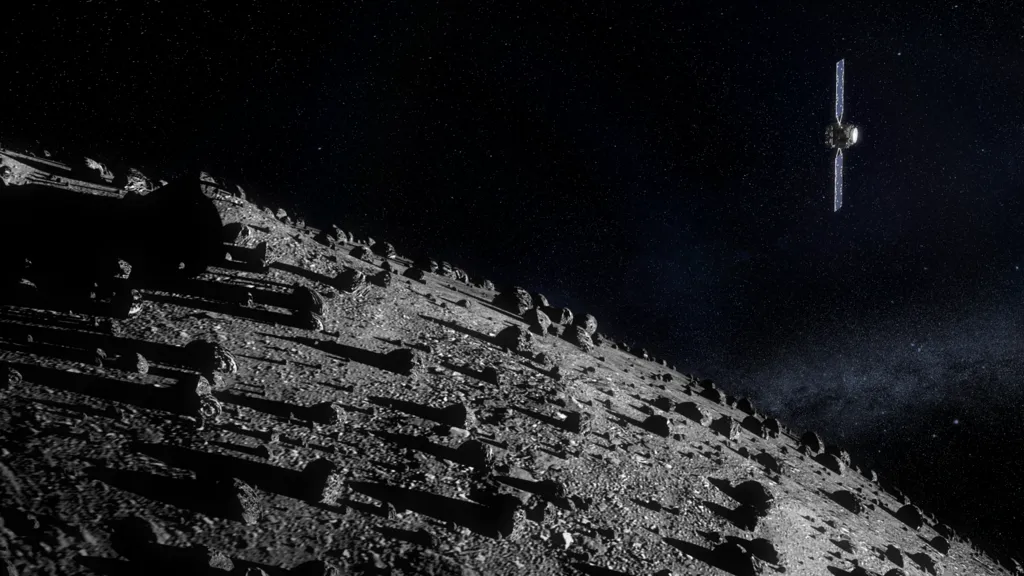
A European Space Agency (ESA) spacecraft has arrived at an asteroid to investigate the impact of a deliberate collision carried out by NASA in 2022 as part of the first major test of Earth’s planetary defence system.
The spacecraft, known as Hera, is on a mission to examine Dimorphos, a 150-metre-wide asteroid that was struck by NASA’s Double Asteroid Redirection Test (DART) spacecraft in September 2022. The mission aims to determine how the collision affected the asteroid and whether it successfully demonstrated a method of changing the movement of space rocks that could threaten Earth.
During the earlier experiment, NASA’s DART spacecraft deliberately crashed into Dimorphos at a speed of approximately 22,000 kilometres per hour, destroying itself on impact. The collision changed the asteroid’s orbital period around its larger companion, Didymos, by about 33 minutes, reducing it from 11 hours and 55 minutes.
The impact also generated a debris trail stretching approximately 10,000 kilometres, which was observed by telescopes in space and on Earth.
Hera will spend the next year examining Dimorphos and its larger companion, Didymos, using scientific instruments and two small satellites designed to study the asteroid more closely. Scientists hope to determine whether the collision created a crater or significantly reshaped the asteroid, as well as measure its mass to understand how effective the impact was.
According to researchers, the findings will help scientists calculate the size, speed and timing of a spacecraft needed to divert an asteroid if one is ever discovered on a collision course with Earth.
The mission is part of wider efforts to improve planetary defence, as medium-sized asteroids could cause serious destruction if they struck populated areas. Scientists have also announced plans for additional asteroid-monitoring missions, including NASA’s Near-Earth Object Surveyor, expected to launch in 2027.









Leave a comment