


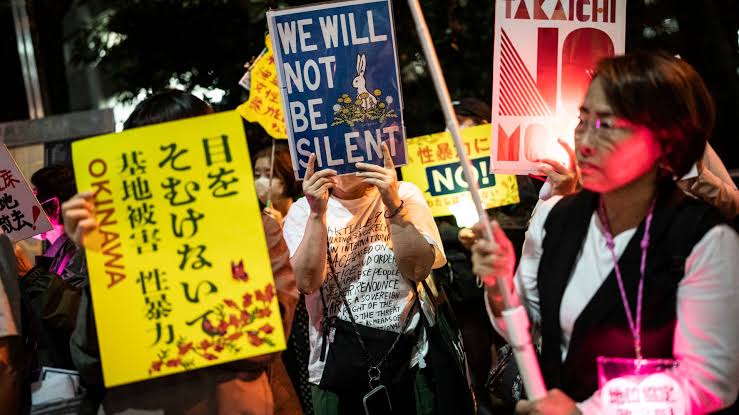
Dozens of protesters gathered outside Japan’s Foreign Ministry in Tokyo on Thursday, condemning crimes allegedly committed by US service members after a US Marine was accused of killing a woman in Okinawa.
Protesters held signs criticizing the US military presence and called on the Japanese government to take stronger action against misconduct by American troops.
The case has renewed concerns over the large US military presence in Okinawa, an island chain strategically located near Taiwan and China. The issue has caused tensions between local residents and authorities for decades and remains sensitive for Japan’s security relationship with the United States.
US Marine Lance Corporal Devin Jacob Ballard, 20, is suspected of killing Anna Yagi, 39, at a hotel in Naha, Okinawa’s capital, last weekend and taking her wallet and backpack. Police said Ballard has denied the allegations.
Thursday’s protesters used loudspeakers to condemn alleged abuses by US military personnel, while others used noisemakers to show their support.
Prime Minister Sanae Takaichi described Yagi’s killing as “extremely brutal and heinous”. The Japanese government has strongly protested to Washington and demanded measures to prevent similar incidents.
Public reaction has so far been smaller than the demonstrations that followed the 1995 rape of a 12 year old Okinawan girl by three US servicemen, which triggered widespread anger over the American military presence.
Japan hosts the largest overseas deployment of US forces, with most of the approximately 18,000 US Marines based in the country stationed in Okinawa. The United States controlled Okinawa from the end of World War Two until 1972.
Residents have repeatedly complained about aircraft noise, accidents and misconduct involving US military personnel.
In response to the latest incident, the US military began a 48 hour suspension of operations and an alcohol ban on Wednesday while troops undergo training on discipline and standards. Service members have also been placed under a month long curfew described as a period of reflection.








Leave a comment