


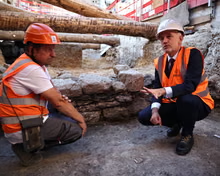
Archaeologists have uncovered an ancient wall beneath central Paris that could provide the strongest physical evidence yet for the location of the city’s original settlement.
The roughly 20-metre structure was discovered beneath the Hôtel-Dieu hospital on the Île de la Cité, close to Notre Dame Cathedral. The stone-and-wood construction is believed to form part of the defensive walls of Lutetia, the settlement associated with the Parisii tribe before Roman rule.
The discovery could help settle a long-running archaeological debate. The Île de la Cité has traditionally been identified as the centre of ancient Lutetia, although another theory places the settlement in present-day Nanterre, west of Paris.
Researchers also found traces of fire on the structure. Carbon dating indicates the charred material dates from between 200BC and 10BC, a period that includes the Battle of Lutetia in 52BC, when Julius Caesar recorded that the Gauls burned their settlement before confronting Roman forces.
French Culture Minister Catherine Pégard described the discovery as potentially one of the most important archaeological remains for understanding ancient Lutetia, while stressing that further scientific work is needed to confirm its exact function and chronology.










Leave a comment