


By Benson Daniel
The Ebola outbreak in the Democratic Republic of the Congo remains a major public health threat, with the World Health Organization warning that transmission is still increasing rapidly in some parts of the country despite signs of improvement elsewhere.
Health officials said the outbreak, caused by the Bundibugyo virus, has now affected seven provinces and recorded more than 7,200 confirmed cases and 3,500 deaths. The outbreak, which began in May, has become the second-deadliest Ebola epidemic on record.
The situation has improved considerably in Ituri Province, which has remained the main centre of the outbreak. Health authorities say the number of new infections has declined from about 120 cases a day at the peak in mid-August to roughly 80 cases daily.
Several health zones have also gone more than three weeks without recording new infections, providing some encouragement to response teams.
However, the improvement in Ituri has been accompanied by a worrying rise in infections in North Kivu, where health officials continue to face significant challenges. The province recorded 555 new cases in the 21 days leading up to September 12, bringing its cumulative confirmed cases to 1,269.
WHO officials have cautioned against interpreting the decline in cases in some areas as evidence that the wider epidemic is under control.
The agency said Ebola outbreaks can show early signs of improvement before transmission rises again, particularly when population movement, insecurity and limited access to healthcare make contact tracing and isolation difficult.
The situation in North Kivu is particularly concerning because of its high population density, population mobility and continuing security problems. These factors are making it more difficult for health workers and humanitarian organisations to reach communities and contain transmission.
The outbreak has also spread beyond eastern Congo, with Sud-Ubangi in the northwest becoming the seventh province to report a case. The development has increased concerns about the possibility of further geographical spread.
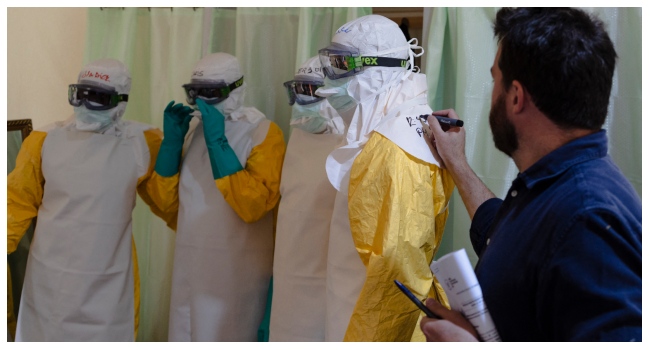
Health authorities and international partners are continuing surveillance, contact tracing, infection prevention measures and vaccination efforts in affected areas. Clinical trials are also underway to identify vaccines and treatments that can effectively target the Bundibugyo strain.
The current outbreak has placed enormous pressure on Congo’s already fragile health system, while insecurity and displacement continue to complicate the response.
WHO officials have therefore urged continued vigilance and sustained international support, stressing that the epidemic could take several more months to bring fully under control.
Although the reduction in daily infections offers some hope, health experts maintain that the fight is far from over, particularly in provinces where new cases are still being recorded at a rapid rate.









Leave a comment