


By Benson Daniel
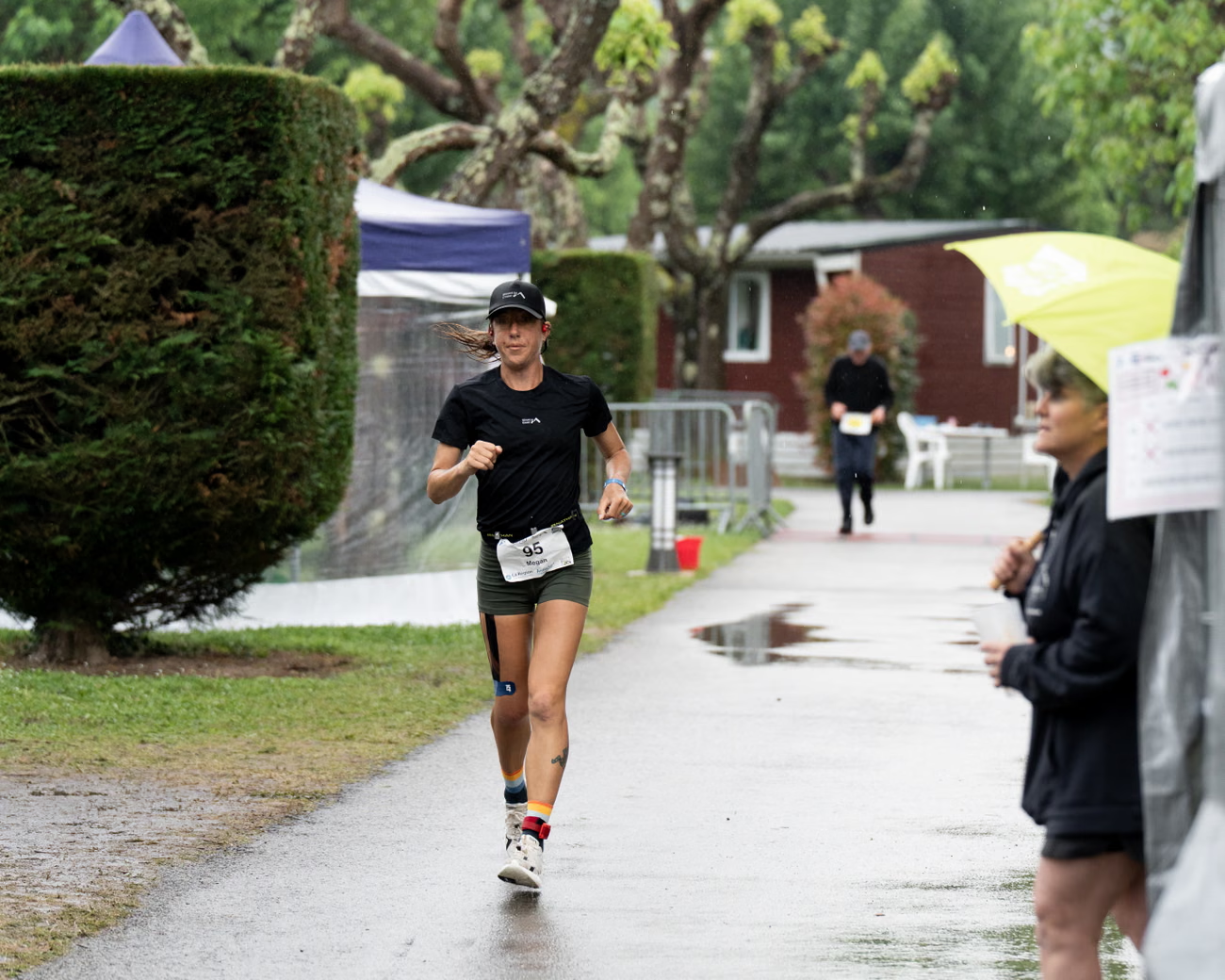
While many teachers are returning to their classrooms, American maths teacher Megan Eckert is preparing for six days of almost continuous running and a chance to rewrite the history of ultradistance racing.
The 40 year old from Santa Fe, New Mexico, is competing at the Global Organization of Multi Day Ultramarathoners World Championship in Balatonfüred, Hungary, where runners will attempt to cover as much distance as possible over 144 hours.
Eckert arrives at the event as the reigning women’s six day world record holder. Last year, she covered 603.156 miles, or about 970.7 kilometres, becoming the first woman to break the 600 mile barrier in a six day race. She now wants to go further and has set her sights on a mark that belongs to an American man.
Her target is the US men’s record of 606.243 miles, meaning she needs to improve her own record by just over three miles to claim both marks.
The challenge is enormous. Six day races are not conventional long distance events in which runners travel from one point to another. Competitors repeatedly circle a relatively short course while the clock continues for six days, stopping only when necessary to eat, sleep, change clothing or deal with injuries and other physical problems.
In Hungary, Eckert will run a 0.558 mile loop. To surpass 606 miles, she would need to complete the circuit at least 1,086 times.
Last year’s record performance already required an extraordinary level of endurance. Eckert relied on short periods of sleep, carefully planned food and support from her crew while dealing with the physical strain of running more than 100 miles a day.
Her background makes the achievement even more striking.
Eckert was once so afraid of failing that she abandoned an attempt to run her first 5K in 2008. Years later, after meeting her husband Joe, she returned to running and completed a half marathon in 2016.
That race changed the direction of her life. Instead of being satisfied with simply reaching the finish line, she began wondering what might happen if she kept going.
She moved into longer and more demanding events, eventually competing in races such as the Badwater 135 and Cocodona 250. She also set a world record in the backyard ultra format, where competitors must complete a 4.16 mile loop every hour for as long as they can continue. Eckert lasted 88 hours and covered 362 miles in 2024.
Her approach to competition is built around deliberately setting targets that appear just beyond her reach.
Eckert has said she prefers goals with roughly a 50 per cent chance of success and a 50 per cent chance of failure. For her, the uncertainty is part of the attraction.
That mindset will be tested repeatedly in Hungary. Six days of running creates a battle not only against fatigue but also against sleep deprivation, pain, nutrition problems and the mental strain of repeatedly covering the same stretch of road.
Eckert says she relies heavily on her support crew to monitor her pace and tell her when she needs to push harder. Rather than constantly calculating her position, she tries to remain focused on the immediate task.
Her record from 2025 has already placed her among the leading figures in ultrarunning. She became the first woman to pass 600 miles in six days and finished third in the worldwide ultrarunner of the year rankings.
Now she has another chance to stretch the boundaries of what is possible.
The significance of the attempt goes beyond the numbers. Eckert’s story is also one of overcoming fear. The runner who once stayed home rather than risk failing in a 5K is now prepared to spend six days testing the limits of human endurance.
Whether she reaches 606 miles or falls short, the attempt itself represents the philosophy that has shaped her career: choose a challenge that is frightening, take the first step and discover what happens next.
For Eckert, the hardest part may not be deciding whether the record is possible. It is simply continuing to put one foot in front of the other for 144 hours.










Leave a comment