


By Benson Daniel
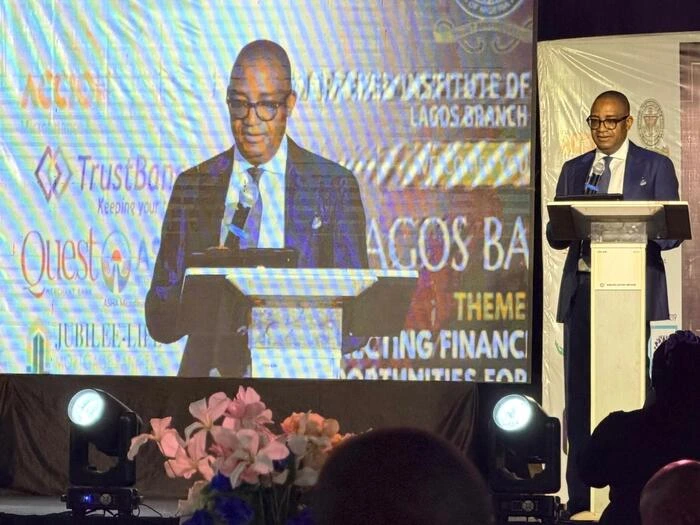
The Group Chief Executive Officer of TrustBanc Financial Group, Abubakar Jimoh, has called for greater use of artificial intelligence in expanding credit access to micro, small and medium enterprises while urging professional bodies to introduce dedicated certifications for fintech practitioners.
Jimoh made the call while delivering the chairman’s address at the 2026 Lagos Bankers’ Fair held on August 13 under the theme, “Connecting Finance, Innovation and Opportunity for a Greater Lagos.”
He argued that stronger collaboration among banks, fintech companies, regulators and professional institutions would help Nigeria build a more inclusive financial system capable of supporting businesses and driving economic growth.
A major focus of his address was the potential of artificial intelligence to transform the way financial institutions assess and extend credit to MSMEs.
Jimoh said AI could enable lenders to examine borrowers’ transaction histories, repayment behaviour and cash flow patterns to determine creditworthiness, particularly for businesses that lack conventional collateral.
He explained that traditional credit assessment often places significant emphasis on collateral, leaving many viable small businesses unable to secure formal financing despite having the capacity to repay loans.
According to him, analysing financial behaviour through AI could make the character and capacity components of credit assessment more measurable, allowing lenders to make faster and better informed decisions.
Nigeria has more than 39 million MSMEs, accounting for the overwhelming majority of businesses and employing a significant share of the country’s workforce. Yet access to formal credit remains limited, creating a substantial financing gap for small businesses.
Jimoh said the application of AI could help bridge that gap by allowing financial institutions to process larger volumes of credit applications while maintaining effective risk assessment.
He stressed that AI enabled lending should not be restricted to fintech companies, arguing that conventional banks and microfinance institutions could equally deploy the technology to reach underserved businesses.
He cited the development of MangoMonie by Mango Microfinance Bank, a subsidiary of TrustBanc, as an example of how data driven lending could be used to assess repayment behaviour and transaction patterns in determining the creditworthiness of individuals and MSMEs.
Beyond credit access, Jimoh called for the development of stronger professional standards within Nigeria’s rapidly expanding fintech industry.
He urged the Chartered Institute of Bankers of Nigeria to move fintech, digital banking and agency banking beyond modules and electives and establish dedicated professional certification programmes for practitioners.
He proposed the creation of a professional qualification such as a Chartered Fintech Practitioner designation to give specialists in the sector formal recognition and help financial institutions develop a workforce with expertise in both digital innovation and financial regulation.
Jimoh also recommended that artificial intelligence become a core component of such professional training, with practitioners expected to understand not only how AI systems work but also how to deploy and govern them responsibly.
He said the financial sector needed professionals capable of balancing innovation with regulatory compliance, risk management and consumer protection as technology continues to reshape banking and financial services.
The TrustBanc chief executive maintained that Lagos was particularly well positioned to lead the integration of traditional banking and fintech, given its concentration of financial institutions, technology companies, skilled professionals, investors and regulatory expertise.
He called on stakeholders across the financial ecosystem to work together to transform innovation into practical solutions that improve access to finance and create greater economic opportunities.
Jimoh said the future of Nigeria’s financial system would depend increasingly on the ability of banks, fintechs, regulators and professional institutions to combine their strengths.
He urged industry leaders to sustain the conversation around technology, credit access and professional development, saying such collaboration could strengthen financial inclusion and support the growth of MSMEs across Nigeria.











Leave a comment