


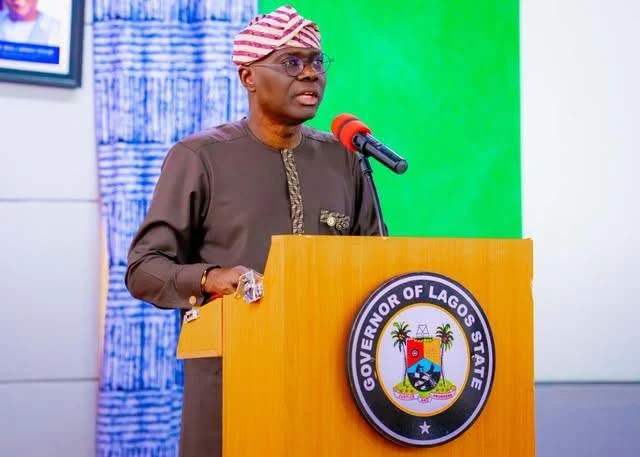
The Lagos State Government has set a target of increasing electricity supply to more than 3,000 megawatts (MW) by March 2027, up from the current level of less than 1,000MW, as the state intensifies efforts to reduce blackouts and support a round-the-clock economy.
Governor Babajide Sanwo-Olu announced the target at the fourth Lagos Business School Africa Energy Conference 2026 in Lagos, where he was represented by Deputy Governor Kadri Obafemi Hamzat.
According to reports published on October 11 and 12, 2026, the governor said the state planned to mobilise an additional 2,000MW through a combination of national grid supplies, independent power projects, energy hubs, power barges, energy traders and embedded generation. <Cite refs={[“turn660674search0″,”turn660674search1”]}/>
The initiative is designed to improve electricity availability for households, commercial establishments and industries, while reducing dependence on unreliable power supply that has increased operating costs for businesses.
Seven-Point Plan to Expand Electricity Supply
Sanwo-Olu outlined a seven-point action plan to address challenges across the electricity value chain and improve the reliability of supply throughout Lagos.
The plan focuses on strengthening the Lagos Electricity Market, expanding power generation, improving distribution capacity, reinforcing transmission infrastructure, upgrading electricity networks and metering, securing reliable gas supplies for power plants, and deploying technology to improve market monitoring.
The governor said achieving the target would require coordinated efforts among electricity generators, transmission operators, distribution companies, regulators and private investors.
The state also intends to strengthen contractual arrangements among market participants to improve accountability and create a more attractive environment for investment in electricity infrastructure.
Private Investment to Drive Power Expansion
The planned expansion will rely on several sources of electricity rather than a single supply channel.
Additional national grid resources will complement independent power projects and embedded generation, which can supply electricity directly to specific industrial, commercial or residential areas.
Energy hubs and power barges are also among the options identified by the government to expand available supply.
The proposed strategy reflects Lagos’ efforts to develop its electricity market and attract private capital to support growing demand from businesses and residents.
However, meeting the March 2027 deadline will depend on the timely delivery of new capacity, improvements to existing infrastructure, adequate gas supply and effective coordination across the sector.
Transmission, Distribution and Metering Upgrades
Beyond increasing generation, the state government plans to strengthen transmission infrastructure, upgrade substations and improve distribution feeders to ensure that additional electricity can reach consumers.
Expanding metering coverage is another priority, particularly as the government seeks to improve billing transparency and reduce disputes associated with estimated electricity bills.
Digital monitoring systems, including Supervisory Control and Data Acquisition (SCADA), Advanced Metering Infrastructure (AMI) and the Lagos Electricity Intelligence Platform, are expected to improve visibility across the electricity market.
These technologies can help operators monitor network performance, identify faults and strengthen accountability in electricity delivery.
The government believes that improvements across the entire supply chain will be necessary to translate additional power capacity into more reliable electricity for consumers.
Lagos Records Progress in Solar Energy
The governor also highlighted progress under the state’s renewable energy programme.
According to figures announced by the administration, approximately 42,000 of the 50,000 streetlights earmarked for solarisation had been completed.
Solar installations had also been completed in 175 public schools, while work was continuing at another 100 schools. <Cite refs={[“turn660674search2″,”turn660674search8”]}/>
The projects form part of efforts to diversify energy sources, improve public infrastructure and reduce reliance on conventional electricity supplies for selected public facilities.
Although solar installations for streetlights and schools do not directly establish how much electricity will be available to the wider grid, they demonstrate the state’s parallel investment in decentralised energy solutions.
Electricity Supply Critical to Lagos Economy
Sanwo-Olu said dependable electricity was essential to industrial growth, job creation, business competitiveness and improved living standards.
Lagos, Nigeria’s commercial hub, has substantial electricity demand from manufacturing companies, technology businesses, markets, offices, hospitals, schools and households.
Unreliable power supply forces many businesses to rely on generators, increasing operating costs and exposing them to fluctuations in fuel prices.
The state government is therefore seeking to improve electricity availability as part of its broader ambition to support a 24-hour economy, in which businesses can operate for longer periods without frequent power interruptions.
The governor called on investors, financial institutions, electricity operators and development partners to support the proposed expansion.
Regulatory Reforms and Implementation Challenges
The power expansion plan comes as Lagos assumes greater responsibility for regulating electricity activities within its territory following reforms introduced under the federal Electricity Act 2023.
In December 2024, the Nigerian Electricity Regulatory Commission transferred regulatory oversight of intrastate electricity activities in Lagos to the Lagos State Electricity Regulatory Commission.
The state subsequently established a framework for licensing and regulating electricity generation, distribution, supply and trading within its jurisdiction. <Cite refs={[“turn660674search0″,”turn660674search2”]}/>
The regulatory changes are intended to encourage investment and enable the state to develop electricity solutions suited to its local needs.
Nevertheless, reaching more than 3,000MW by March 2027 will require more than regulatory reforms and announcements. New electricity sources must become operational, transmission and distribution constraints must be addressed, and consumers must receive reliable supply.
The extent to which the target is achieved will ultimately be measured by the additional electricity delivered and the improvements experienced by households and businesses.
For Lagos residents and the business community, the proposed expansion offers the prospect of more reliable power, lower dependence on private generators and improved conditions for economic activity. The immediate challenge for the state government is to turn its ambitious target into measurable results within the announced timeframe.








Leave a comment