


By Benson Daniel
A new report released through the US Department of Health and Human Services has triggered fierce criticism from researchers and legal experts after appearing to link support for transgender people and gender affirming care with authoritarian political beliefs and support for political violence.
The report has been described by critics as deeply flawed and politically motivated, with researchers questioning its methodology, transparency and decision to present the findings without the normal process of peer review.
The study examines what it calls “gender ideology” alongside what researchers describe as left wing authoritarianism. It argues that people who support transgender rights and positions associated with major medical organisations may also be more likely to express support for certain forms of political violence.
Critics, however, say the research was structured in a way that made its conclusions highly predictable. Epidemiologists and scholars who study authoritarianism and political violence have questioned the way the survey was designed and the measures used to assess respondents’ political attitudes.
Gideon Meyerowitz Katz, an epidemiologist who reviewed the research, described it as unusually political and raised concerns about its scientific quality. Other experts have also questioned why the report was presented through a federal health department rather than subjected to the conventional academic publication process.
Legal experts have raised separate concerns about the report’s publication and dissemination. Daniel Aaron, a law professor who studies health and scientific regulation, argued that influential scientific material produced by the federal government can be subject to requirements for appropriate review before being distributed publicly.
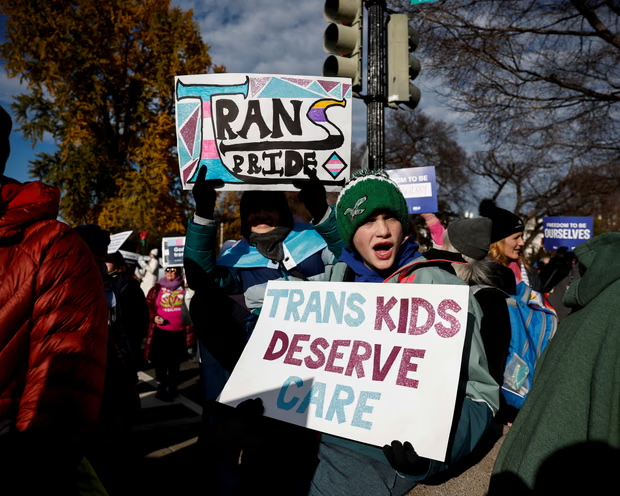
The controversy comes as the Trump administration continues to pursue a broad rollback of federal policies supporting transgender people and gender affirming healthcare. The administration has sought to restrict access to such treatment for minors and has taken steps that could limit federal support for healthcare providers offering gender affirming services.
The latest report has therefore been viewed by opponents as part of a wider political campaign rather than an isolated scientific publication.
Researchers have also criticised the document for failing to adequately engage with existing research that does not support its conclusions. Scholars who study political violence and authoritarianism say the relationship between political beliefs and violence is considerably more complicated than the report suggests.
The report’s treatment of transgender identity has also attracted criticism. Experts say that grouping support for transgender people, acceptance of gender identity and political violence into a single framework risks creating an association that the underlying evidence does not establish.
The controversy has added to concerns about the growing politicisation of federal health agencies under the Trump administration. Critics fear that government backed documents presented as scientific research could weaken public confidence in medical institutions if their conclusions appear to be driven by political objectives.
The administration, meanwhile, has continued to challenge the positions of major medical organisations on gender affirming care. HHS has published other reports questioning established approaches to the treatment of gender dysphoria, including a report released in August that sharply criticised doctors and hospitals providing gender related care.
The dispute comes at a particularly sensitive moment for transgender Americans, with healthcare access, education policy and legal protections increasingly becoming subjects of political conflict across the United States.
For critics of the new report, the central concern is not simply its conclusions but the decision to give a disputed piece of research the weight and visibility associated with an official federal health publication.
They argue that scientific credibility depends on transparent methods, independent scrutiny and engagement with evidence that challenges a study’s assumptions. Without those safeguards, they say, government backed research risks becoming another instrument in an increasingly polarised political debate.













Leave a comment