


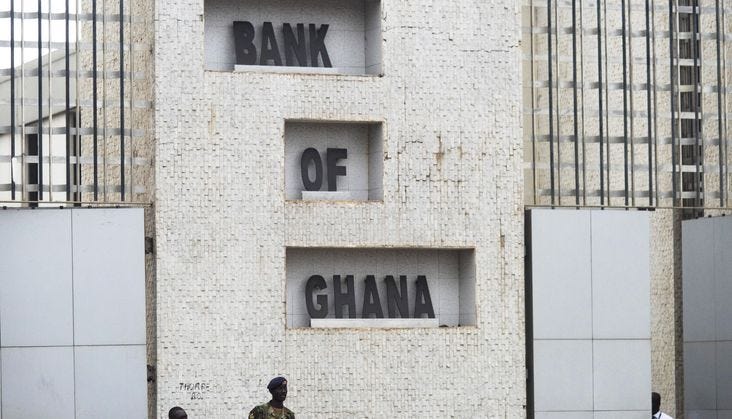
Ghana has opened a voluntary bond buyback programme targeting up to GH¢28.58 billion in government securities due to mature in February 2027, marking another significant step in the country’s efforts to manage its domestic debt obligations and strengthen investor confidence.
The auction, which commenced on Monday, November 23, allows eligible bondholders to sell their holdings ahead of the scheduled maturity date of February 16, 2027.
According to an announcement issued by Ghana’s Ministry of Finance through the Public Debt Management Office, the transaction involves the repurchase and cancellation of a specific Ghanaian cedi-denominated Treasury bond issued under the country’s Domestic Debt Exchange Programme (DDEP).
The offer is voluntary and open to all holders of the eligible security.
The government has scheduled the auction to close at 3 p.m. on Wednesday, November 25, with settlement expected on Thursday, November 26.
How Ghana’s Bond Buyback Will Work
The transaction targets the February 2027 government bond identified by International Securities Identification Number GHGGOG069915.
Under the arrangement, investors willing to exit their positions before maturity can submit offers through designated primary dealers appointed to facilitate the transaction.
The government will evaluate submissions on a yield basis, with successful offers accepted through a multiple-clearing-level auction mechanism.
Participating financial institutions include Absa, CalBank, Ecobank, Fidelity Bank, Consolidated Bank Ghana, ARB Apex Bank, Standard Chartered Bank, Société Générale, GCB Bank and Stanbic Bank, alongside other authorised dealers.
Importantly, participation is not compulsory. Investors who decline the offer can retain their securities until the contractual maturity date.
The structure provides the government with an opportunity to reduce its outstanding obligations before the scheduled repayment period while giving investors an alternative route to liquidity.
Ghana’s Debt Restructuring Legacy
The buyback represents another stage in Ghana’s broader efforts to rebuild its domestic debt market following the financial pressures that forced the government to restructure its public debt.
In December 2022, Ghana launched its Domestic Debt Exchange Programme as part of a wider strategy to restore debt sustainability and address mounting government financing pressures.
The programme involved exchanging existing domestic government securities for new instruments with revised repayment schedules and lower interest obligations.
Although the restructuring helped reduce immediate debt-servicing pressures, it imposed significant financial costs on domestic investors, particularly banks, insurance companies and pension funds.
The latest buyback therefore carries significance beyond the immediate transaction. It provides an opportunity to reduce outstanding restructured obligations while potentially improving confidence in the government’s ability to honour its repayment commitments.
Why the February 2027 Maturity Matters
Ghana faces substantial domestic debt repayments over the next two years.
Finance Minister Cassiel Ato Forson has indicated that approximately GH¢58 billion in Domestic Debt Exchange Programme bonds will mature in 2027, followed by another GH¢53 billion in 2028.
The February 2027 maturity represents a particularly important component of those obligations.
By offering to repurchase up to GH¢28.58 billion ahead of schedule, the government is attempting to manage a significant portion of its near-term repayment exposure before the contractual maturity date.
The exercise also follows the government’s October–December 2026 issuance calendar, which explicitly identified buybacks of the 2027 DDEP bonds as part of its liability management operations.
The Ministry of Finance has linked these operations to the full operationalisation of the sinking fund established to prepare for repayment of the restructured securities.
Implications for Ghana’s Financial Sector
The outcome of the auction will be important for Ghana’s domestic financial institutions, many of which were affected by the original debt restructuring.
Banks, pension funds and insurance companies were among the investors exposed to the DDEP, making the repayment of restructured securities an important consideration for their balance sheets and investment portfolios.
For Nigerian financial institutions with exposure to Ghana’s banking market, developments in the country’s domestic debt market also carry regional significance.
Ghana’s 2022 debt restructuring generated substantial impairment charges for Nigerian banks with exposure to Ghanaian government securities.
Institutions including Access Bank, Zenith Bank, United Bank for Africa, Ecobank and Guaranty Trust Holding Company were among those affected.
The early repayment initiative could therefore have implications beyond Ghana’s domestic financial system, although the eventual benefits will depend on the securities held by individual institutions and the prices at which their offers are accepted.
What Happens Next?
The immediate focus is on investor participation and the final value of securities the government successfully repurchases.
Although the programme provides for a maximum buyback of GH¢28.58 billion, the final amount will depend on the offers submitted and accepted during the auction.
The government will settle successful transactions on November 26, one day after the scheduled auction closing.
For investors, the exercise offers an opportunity to assess whether accepting the government’s repurchase terms is more attractive than holding the securities until February 2027.
For Ghana, the broader objective is to demonstrate that its debt management strategy can move beyond restructuring towards orderly repayment, improved liquidity and a more predictable domestic securities market.
The success of the exercise will ultimately be measured not simply by the amount of debt repurchased, but also by its contribution to fiscal stability and the restoration of confidence among domestic investors.






Leave a comment