


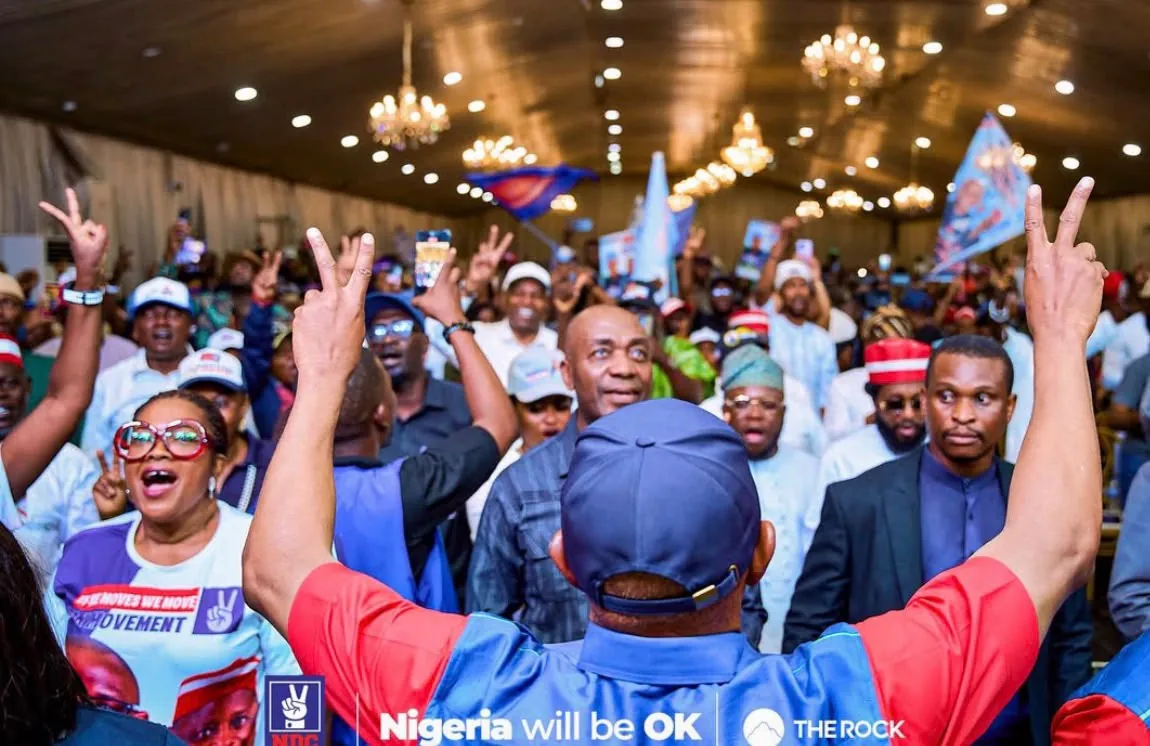
The presidential candidate of the Nigeria Democratic Congress (NDC), Peter Obi, and supporters of the party rejected Nigeria’s newly reintroduced national anthem during a town hall meeting in Lagos on Thursday, opting instead to recite the old national anthem.
The development occurred during the gathering at Classique Event Place, Oregun, Ikeja, where Obi was expected to address party supporters and other stakeholders ahead of the 2027 general elections.
In a video circulating on social media, Obi, alongside the NDC governorship candidate in Lagos State, Funso Doherty, and other supporters, declined to stand when the new national anthem was introduced for recitation.
The event anchor subsequently switched to the former national anthem, ‘Nigeria, We Hail Thee’, which was enthusiastically recited by attendees.
Obi was seen facing the crowd as they sang the old anthem, raising two fingers on both hands to form the NDC symbol.
The incident has attracted attention because President Bola Tinubu signed into law the National Anthem Bill on May 29, 2024, restoring the old anthem, which was used between Nigeria’s independence in 1960 and 1978.
The decision to recite the former anthem came amid tension at the town hall meeting following an attack by suspected political thugs who disrupted the gathering.
The attackers reportedly stormed the venue armed with cutlasses, cudgels and stones, causing panic among participants and forcing some attendees to flee.
The confrontation reportedly resulted in injuries and damage to vehicles and other properties around the venue.
Some NDC supporters resisted the attackers, leading to a clash that further disrupted the meeting.
The Lagos State Police Command subsequently arrested a suspected attacker identified as Ibrahim in connection with the incident.
The suspect, however, denied being recruited to attack the gathering, claiming that he had visited the venue to beg for money.
The attack also generated political reactions, with NDC supporters accusing the All Progressives Congress (APC) of being behind the incident.
However, the Lagos State chapter of the APC denied involvement, challenging the opposition party to provide evidence supporting its allegations.
The development has renewed concerns about political violence and intimidation ahead of the 2027 general elections.
Meanwhile, the House of Representatives has constituted an ad hoc committee to investigate reported cases of political violence, attacks on political gatherings and disruption of political activities across the country.
The committee was established following a motion of urgent public importance sponsored by the House Minority Leader, Fred Agbedi, and 16 other lawmakers.
The lawmakers expressed concern that attacks on political gatherings could undermine democratic participation and threaten the peaceful conduct of the forthcoming elections.
The Lagos incident has also drawn attention to the need for security agencies to protect political parties and ensure that candidates and their supporters can exercise their constitutional rights without intimidation.






Leave a comment