


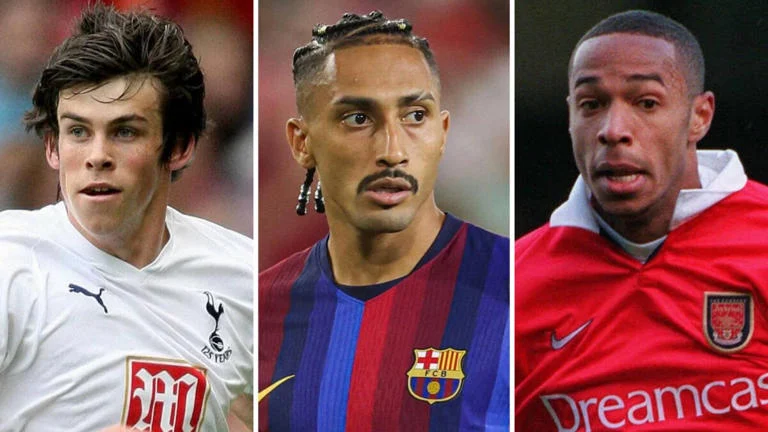
Raphinha’s remarkable transformation at Barcelona has highlighted how a change of position can unlock another level in a footballer’s career.
The Brazil international made his name as a right winger during his Premier League days, but has demonstrated impressive versatility since joining Barcelona. After an outstanding 2024-25 campaign operating from the left, Raphinha has now started the new season as a central striker under manager Hansi Flick.
His evolution places him among a long list of top players who flourished after being moved into unfamiliar roles.
According to Planet Football, these are 15 notable players whose careers benefited significantly from positional changes.
Thierry Henry
When Arsenal signed Henry from Juventus in 1999, the Frenchman was primarily regarded as a winger following a difficult spell in Italy.
Arsène Wenger, however, saw greater potential in him as a striker. Henry initially struggled, failing to score in his first seven Premier League appearances, but eventually adapted brilliantly.
He went on to become one of Arsenal’s greatest players, scoring 228 goals in 376 appearances for the club.
Gareth Bale
Bale’s emergence as one of the world’s most dangerous attackers came after he moved away from his original role as a left-back.
His spectacular hat-trick against Inter Milan at San Siro in 2010, despite Tottenham’s 4-3 defeat, announced him as an attacking force. The Welshman subsequently became a devastating winger before eventually developing into a forward capable of scoring at an elite level.
Cristiano Ronaldo
Ronaldo initially established himself as a winger during his Manchester United career, but Sir Alex Ferguson gradually moved him into more central attacking positions.
The tactical adjustment allowed Ronaldo to focus increasingly on goals, with Wayne Rooney and Carlos Tevez often moving wider to accommodate him.
His eventual transition into a central striker helped pave the way for the extraordinary scoring record he would later establish at Real Madrid and beyond.
Ousmane Dembélé
Dembélé arrived at Barcelona as an exciting winger, but injuries and inconsistent form prevented him from reaching his full potential during much of his time in Spain.
His career took another turn at Paris Saint-Germain, where Luis Enrique increasingly deployed him as a central attacker.
The Frenchman has excelled in the role, helping PSG to major honours and eventually winning the Ballon d’Or.
Ryan Giggs
For most of his Manchester United career, Giggs was one of football’s classic wingers, relying on his pace, skill and direct running.
As he entered the latter stages of his career, however, the Welshman moved into central midfield.
His experience and passing ability allowed him to control games from deeper positions and provide service for United’s more attack-minded players.
Bastian Schweinsteiger
Schweinsteiger spent much of the early part of his career operating in wide positions before establishing himself in central midfield.
His finest example came in the 2014 World Cup final, when he delivered a heroic performance from the middle of the pitch as Germany defeated Argentina.
Despite suffering a facial injury during the match, Schweinsteiger completed the contest and lifted the World Cup.
Andrea Pirlo
Pirlo began his career as an attacking midfielder, playing in a No. 10 role during his early years at Brescia, Inter Milan and Reggina.
His career changed dramatically when Carlo Ancelotti moved him deeper at AC Milan.
Operating in front of the defence allowed Pirlo to dictate the tempo, control possession and utilise his exceptional passing range, ultimately establishing him as one of the greatest deep-lying playmakers of his generation.
Joelinton
Joelinton arrived at Newcastle United in 2019 as a £40 million striker and initially struggled to justify the club-record fee.
He scored only six Premier League goals across his first two seasons.
Eddie Howe’s decision to move him into midfield transformed his fortunes. Joelinton became a key figure in Newcastle’s midfield, developed into a fan favourite and was part of the team that ended the club’s long trophy wait by winning the 2025 Carabao Cup.
Philipp Lahm
Lahm was already regarded as one of the finest full-backs in world football before Pep Guardiola arrived at Bayern Munich.
Guardiola subsequently moved the German into midfield, where his intelligence, positioning and passing allowed him to excel once again.
The tactical switch demonstrated Lahm’s remarkable ability to perform at the highest level in different positions.
Fabinho
Fabinho began his senior career as a full-back before moving into defensive midfield during his time at Monaco.
The positional change proved decisive. He later joined Liverpool and became a crucial component of Jürgen Klopp’s midfield, establishing himself as one of the leading defensive midfielders in world football.
Ben White
White joined Arsenal from Brighton in 2021 primarily as a centre-back and formed a strong partnership with Gabriel Magalhães.
The emergence of William Saliba created competition for central defensive places, prompting Mikel Arteta to move White to right-back.
The switch enabled Arsenal to accommodate all three defenders and allowed White to develop into a highly influential full-back.
Javier Mascherano
Mascherano arrived at Barcelona as a defensive midfielder but found opportunities limited in a midfield containing Sergio Busquets, Xavi and Andrés Iniesta.
He subsequently reinvented himself as a centre-back.
Despite having little experience in the position, Mascherano adapted remarkably well and went on to make 334 appearances for Barcelona.
Antonio Valencia
Valencia initially made his name as a winger after joining Manchester United from Wigan Athletic.
However, after taking the famous No. 7 shirt, his form dipped and he eventually switched to right-back.
The move revitalised his career, with José Mourinho later describing Valencia as the best right-back in the world.
Gianluca Zambrotta
Zambrotta joined Juventus from Bari as an exciting winger before a positional change reshaped his career.
An injury during the 2002 World Cup opened the door for Mauro Camoranesi, while Zambrotta was subsequently converted into a full-back.
He became capable of playing on either side of the defence and went on to win major honours with Juventus, Barcelona and AC Milan, as well as the 2006 World Cup with Italy.
Lothar Matthäus
Matthäus spent much of his career as a dominant central midfielder and was instrumental in Germany’s 1990 World Cup triumph.
At the beginning of his career, he scored 168 goals in 12 seasons as a midfielder.
Later, he reinvented himself as a defender and sweeper. Remarkably, at the age of 38, Matthäus was again named German Footballer of the Year after excelling in his new defensive role at Bayern Munich.
From Henry and Ronaldo to Pirlo, Joelinton and Dembélé, their stories demonstrate how tactical reinvention can extend careers, unlock new qualities and sometimes transform talented players into global stars.







Leave a comment