


By Benson Daniel
Canadian Prime Minister Mark Carney has called for stronger economic and strategic cooperation between Canada and the European Union, as tensions with the United States grow over a proposal to give Canada associate membership of the bloc.
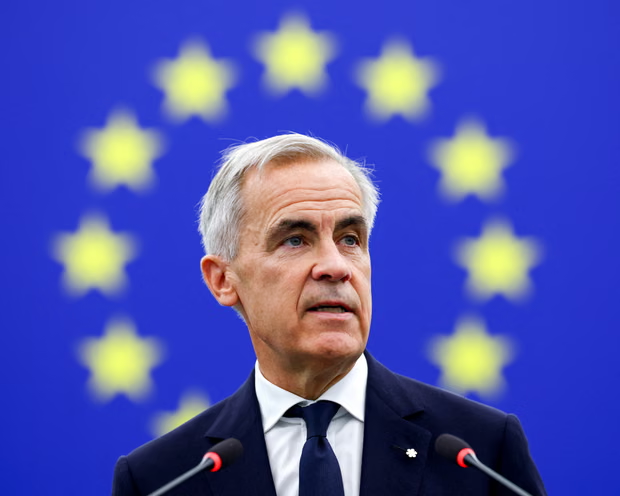
Addressing the European Parliament in Strasbourg on Thursday, Carney welcomed the idea of Canada becoming the European Union’s first associate member and argued that closer ties could strengthen both sides in an increasingly uncertain global economy.
Carney said Canada and Europe should deepen cooperation in areas including trade, energy, critical minerals, defence, digital technology, artificial intelligence and research. He presented the relationship as a way of strengthening the ability of both sides to protect their economic interests and reduce excessive dependence on individual trading partners.
The Canadian leader also called for greater “strategic autonomy”, stressing the importance of countries working together while retaining their sovereignty. His message comes as Canada seeks to broaden its international economic relationships amid continuing tensions with Washington.
The proposed associate membership was put forward by European Commission President Ursula von der Leyen, who said Canada could become the EU’s first country to hold such a status. The proposed arrangement would go beyond the existing Canada-EU trade relationship, although the precise terms and legal structure of associate membership have yet to be established.
The proposal has drawn a strong reaction from US President Donald Trump, who warned that Washington could respond with heavy tariffs or restrictions on trade with Europe if the EU proceeds with the plan.
Trump described the proposed Canada-EU arrangement as potentially hostile to the United States, escalating an already difficult period in transatlantic trade relations. The warning adds another layer of uncertainty for businesses operating across North America and Europe, particularly as Canada and the United States continue to face unresolved trade disagreements.
For Canada, closer European ties could provide greater access to alternative markets and strengthen cooperation in sectors considered strategically important, including energy and critical minerals. For the EU, a deeper relationship with Canada could expand access to resources and reinforce economic and security cooperation with a major democratic partner outside the bloc.
However, the proposal faces practical and political hurdles within Europe. Associate membership would be a new arrangement for the EU, and its scope, trade privileges and institutional implications would have to be worked out before any agreement could take effect.
The dispute also illustrates the broader changes taking place in global trade. Canada and European countries are increasingly examining ways to diversify supply chains, strengthen strategic industries and reduce vulnerability to disruptions caused by geopolitical disputes.
Carney’s visit therefore comes at a sensitive moment for relations between North America and Europe. While Canada is seeking closer integration with European partners, Trump’s warning indicates that such a move could have consequences for the wider US-Europe trading relationship.











Leave a comment