


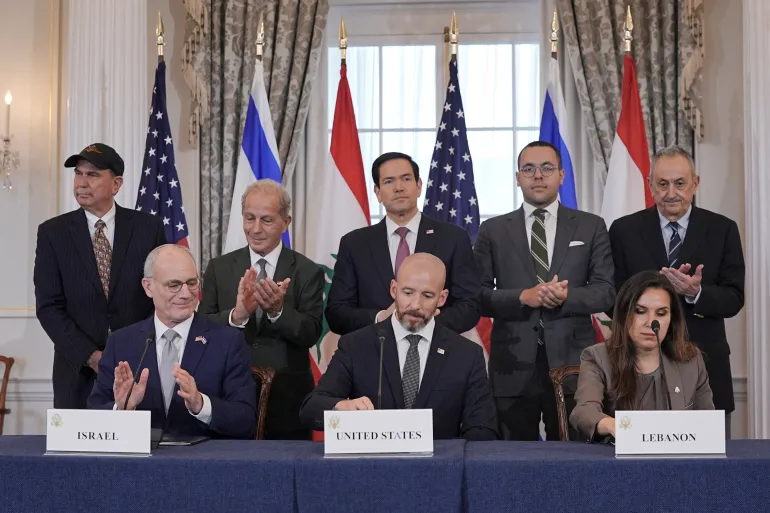
A newly signed understanding between Lebanon and Israel, intended to reduce tensions after months of conflict, has sparked intense political debate in Lebanon, with critics warning that the agreement could create the conditions for future instability rather than lasting peace.
According to an analysis published by Al Jazeera, the agreement has drawn strong opposition from Hezbollah, its allies, and other political groups, who argue that the framework is politically contentious, difficult to implement, and could ultimately leave Lebanon bearing responsibility if hostilities resume.
Concerns Over Implementation
The analysis argues that while the agreement reflects a shared intention to reduce conflict, many of its provisions may prove impractical.
One of the central concerns is the expectation that the Lebanese state will assume full control over security matters, including areas where Hezbollah remains a dominant military and political force.
Analysts note that Hezbollah’s armed presence is deeply rooted in Lebanon’s political landscape and cannot simply be dismantled through a diplomatic agreement. At the same time, the Lebanese Armed Forces continue to face financial, logistical, and operational challenges that limit their ability to assume full responsibility for national defence.
According to the analysis, this places Lebanon in the difficult position of accepting obligations that exceed the state’s current institutional and military capacity.
Constitutional and Political Questions
The agreement has also raised constitutional concerns within Lebanon.
The analysis argues that if the document creates obligations relating to national security, territorial issues, or international commitments, it may require broader constitutional approval rather than being treated as a simple political declaration.
Critics contend that major decisions involving war, peace, or international agreements should pass through Lebanon’s established constitutional institutions, including the Council of Ministers, rather than relying solely on executive approval.
Political opponents are therefore expected to challenge aspects of the agreement through parliamentary procedures, cabinet discussions, and constitutional debates.
Regional Dynamics Remain Key
The analysis further suggests that the success or failure of the agreement will depend less on the document itself than on wider regional developments involving Iran, the United States, and other international mediators.
Hezbollah’s future actions, it argues, will largely depend on broader regional calculations rather than solely on commitments contained in the agreement.
Should diplomatic efforts between regional and international actors falter, the agreement may do little to prevent renewed military confrontation.
Fear of Future Justification for Conflict
One of the report’s main arguments is that the agreement could provide Israel with political and diplomatic grounds to accuse Lebanon of failing to meet its commitments if Hezbollah remains armed, if the Lebanese military is unable to deploy as expected, or if Beirut pursues legal action against Israel in international forums.
According to the analysis, such accusations could be used to justify future military action, potentially increasing rather than reducing the risk of another conflict.
Sovereignty at the Centre of the Debate
The analysis concludes that Lebanon faces a broader challenge of strengthening its sovereignty through stronger state institutions, a capable national army, constitutional governance, and greater political consensus.
Without addressing these underlying issues, it argues, diplomatic agreements alone are unlikely to deliver lasting stability and may instead expose the limitations of the Lebanese state’s current capacity.
Source: Al Jazeera.











Leave a comment