


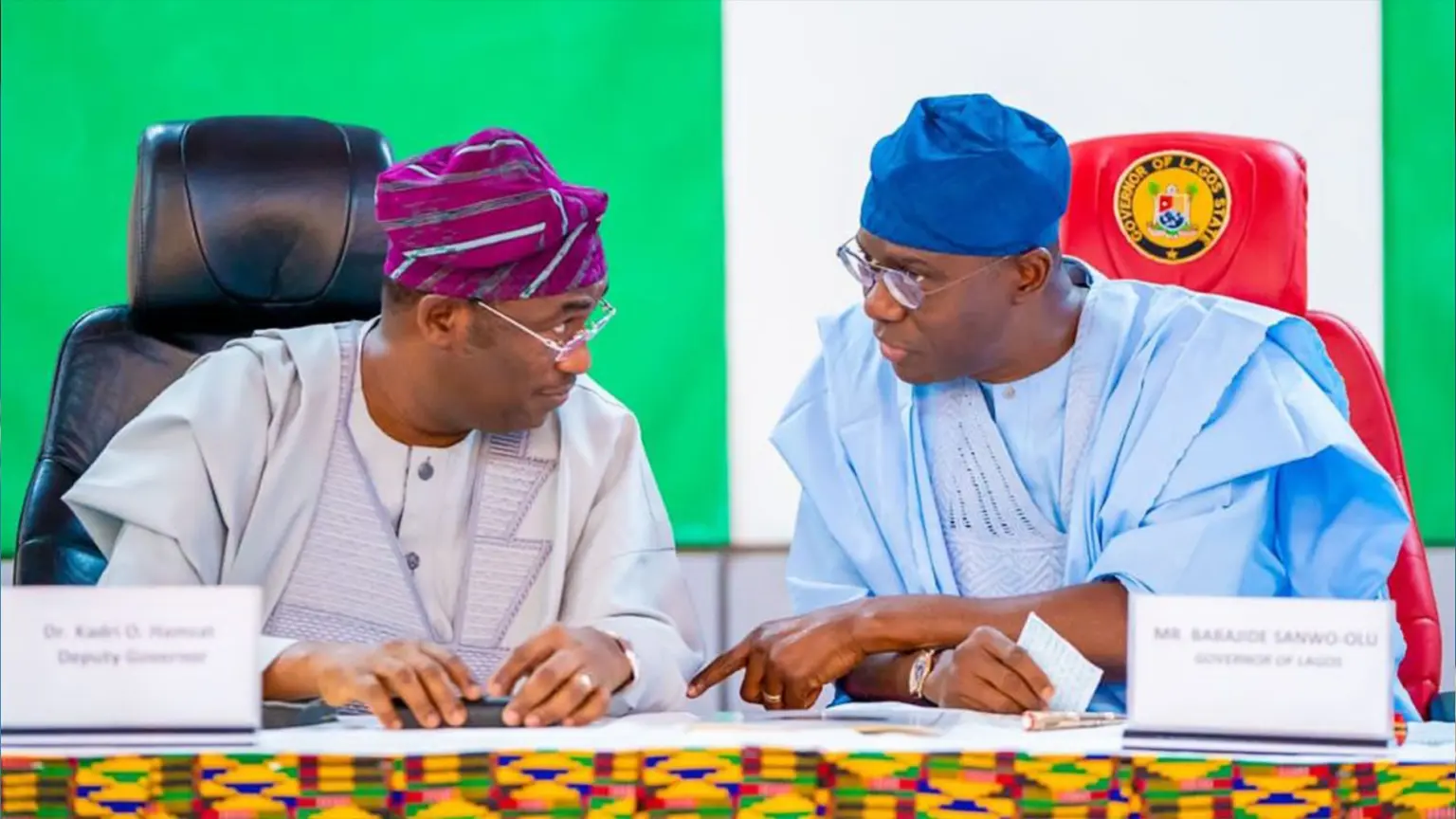
The 2027 Lagos governorship election is shaping up to be a major political contest as the ruling All Progressives Congress seeks to extend its 27-year control of the state, with its candidate, Deputy Governor Obafemi Hamzat, facing the challenge of convincing voters that the party deserves another term.
Since Nigeria returned to democratic rule in 1999, Lagos has remained under the control of the same political establishment, which began with the Alliance for Democracy before evolving into the Action Congress, Action Congress of Nigeria and eventually the APC.
The political succession has seen former governors Bola Tinubu, Babatunde Fashola, Akinwunmi Ambode and the incumbent, Babajide Sanwo-Olu, govern the state.
Their administrations have pursued different development programmes, particularly in infrastructure, transportation, revenue generation, education and urban renewal.
However, as the 2027 election approaches, questions are emerging over whether the achievements recorded under successive APC administrations have sufficiently improved the living conditions of ordinary Lagos residents.
For millions of Lagosians, the major concerns remain rising accommodation costs, traffic congestion, expensive transportation, unemployment, inadequate healthcare facilities and the increasing cost of living.
Hamzat’s emergence as the APC governorship candidate followed his endorsement by Sanwo-Olu, who expressed confidence in his deputy’s experience and capacity to sustain the administration’s development agenda.
The endorsement has placed Hamzat at the centre of the debate over continuity, accountability and the future direction of Lagos.
APC’s development scorecard
The APC’s argument for another term rests largely on its record of infrastructure development and institutional reforms over the past 27 years.
Tinubu’s administration between 1999 and 2007 laid foundations through revenue reforms, improved urban management and efforts to strengthen Lagos’s commercial position.
Fashola’s administration between 2007 and 2015 expanded investments in roads, public transportation, environmental management and urban renewal.
Ambode continued infrastructure development, while the Sanwo-Olu administration introduced additional projects in transportation, healthcare, housing and education.
Among the major achievements highlighted by the current administration are the Blue Line and Red Line rail projects, road construction, hospital improvements and housing developments.
The Lagos State Government disclosed in June 2026 that it had completed 362 roads covering approximately 347 kilometres since 2019.
The Blue Line rail service, which commenced commercial operations in September 2023, transported approximately 3.5 million passengers in 2025.
The government has also reported delivering 10,623 housing units since 2019.
Despite these achievements, concerns remain about affordability, accessibility and the extent to which the projects have benefited low-income residents.
Hamzat’s promises for 2027
In his governorship manifesto unveiled on October 30, 2026, Hamzat outlined plans to expand transportation, healthcare, housing, education and employment opportunities.
He promised to increase the state’s public bus fleet from 1,000 to 4,000, upgrade 100 primary healthcare centres and increase maternal and child healthcare facilities from 10 to 15.
He also pledged to provide 580 additional hospital beds, build two general hospitals and expand health insurance coverage under the Ilera Eko scheme.
On housing, Hamzat promised affordable accommodation through a 10 per cent initial deposit and single-digit interest rates.
His plans also include expanding vocational training, creating employment opportunities for young people, improving public education and strengthening neighbourhood security.
However, one of the most significant infrastructure commitments remains the proposed Fourth Mainland Bridge.
First proposed during Tinubu’s administration in 2003, the project has experienced several delays, revised designs and financing arrangements.
Despite renewed commitments under successive administrations, construction had yet to commence as of January 2026.
For residents who spend several hours commuting between Ikorodu, the mainland and the Lekki-Epe corridor, the bridge represents an important opportunity to address transportation difficulties.
A commercial bus driver, Salau Akanni, told The Guardian that completing the project would significantly improve transportation in Lagos.
He explained that travelling from Ikorodu to Ajah could take between three and four hours in the morning, with similar delays on the return journey.
Economic hardship and voters’ expectations
Beyond infrastructure, the economic situation is expected to influence voters’ decisions in 2027.
The removal of petrol subsidy and foreign exchange reforms introduced by the Federal Government have increased transportation, food and business operating costs.
Although the government has defended the reforms as necessary for economic recovery, many households continue to struggle with rising living expenses.
Consequently, Hamzat will have to convince residents that another APC administration can address their economic difficulties.
Voters are likely to demand practical solutions that go beyond road construction and major infrastructure projects.
Opposition parties seek an alternative
Despite the APC’s longstanding political dominance, opposition parties are preparing to challenge its control of Lagos.
In the 2023 governorship election, Sanwo-Olu secured 762,134 votes, while the Labour Party candidate, Gbadebo Rhodes-Vivour, polled 312,329 votes.
The result demonstrated that opposition parties could attract significant support, although their efforts were insufficient to defeat the ruling party.
However, internal divisions, leadership disputes, defections and weak grassroots structures have continued to affect opposition parties.
Former Lagos PDP chairman, Tunji Shelle, attributed the opposition’s difficulties partly to internal disagreements and what he described as political strategies by the ruling party to weaken its opponents.
Meanwhile, Rhodes-Vivour, who is now the African Democratic Congress governorship candidate, insisted that his political structure had grown since the 2023 election.
He said his continued engagement with communities, particularly residents affected by demolitions, had strengthened his grassroots support.
He maintained that the opposition remained committed to providing an alternative government that would prioritise residents’ welfare.
What Lagos voters want
As the 2027 election approaches, the major challenge for Hamzat and the opposition will be demonstrating how their proposed policies will improve everyday life.
While the APC will rely on its development record and experience in government, the opposition is expected to campaign on accountability, affordability, employment and improved public services.
Ultimately, Lagos voters will have to decide whether to reward the ruling party for its achievements, demand better performance or embrace an alternative political direction.
The outcome may depend less on political endorsements and campaign slogans than on which candidate can present convincing solutions to the challenges facing ordinary residents.





Leave a comment