


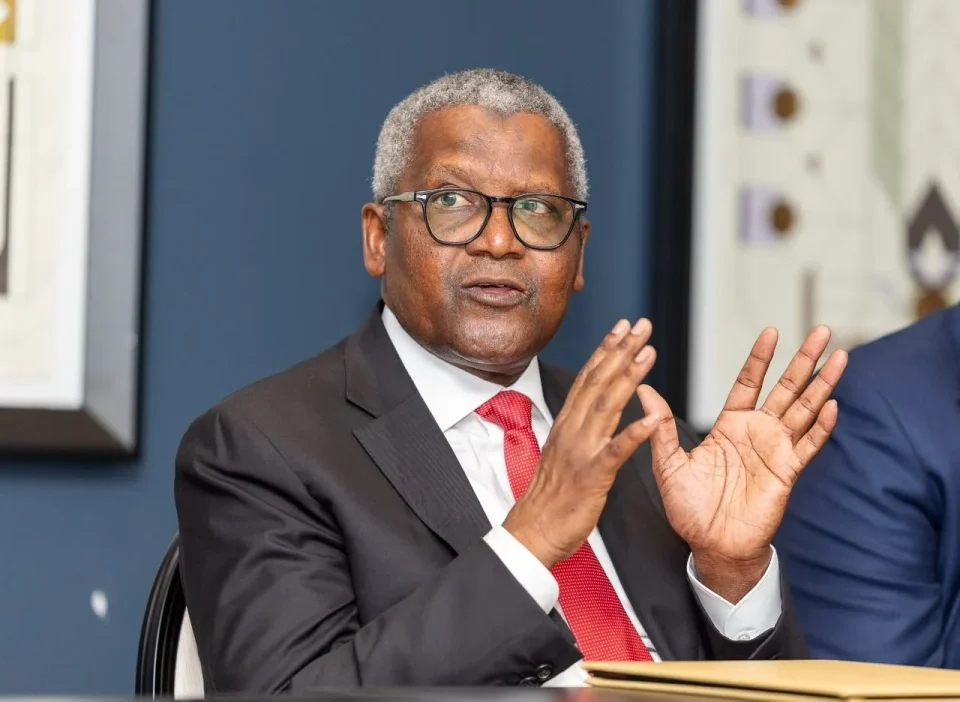
President and Chief Executive of Dangote Industries Limited, Aliko Dangote, has revealed that his company paid interest rates of up to 40 per cent to Nigerian banks while financing the construction of its Obajana Cement plant in Kogi State.
Dangote made the disclosure on Thursday during the 25th annual conference of Women in Management and Business (WIMBIZ) in Lagos, where he encouraged women entrepreneurs to pursue ambitious investments in industrial businesses. He explained that the Obajana project, which was initially expected to cost about $180m, experienced significant financial challenges due to inadequate infrastructure and operational difficulties.
According to him, the company began the project when Nigerian banks had a combined capital base of about ₦25bn, making access to affordable financing difficult. Dangote said the company initially relied on the government’s assurances that essential infrastructure, including electricity and gas supply, would be available. As a result, it did not include facilities such as gas pipelines, fuel infrastructure and power plants in its original plans.
However, the lack of these facilities created operational challenges and contributed to the project’s cost rising to approximately $1bn. The company subsequently approached the International Finance Corporation (IFC) for additional financing. Dangote said the organization rejected the proposed three-year repayment plan after reviewing the company’s financial projections and instead offered a seven-year arrangement, including an initial two-year repayment grace period.
Despite the extended arrangement, borrowing from local banks remained expensive, with interest rates reaching 40 per cent. Dangote disclosed that he eventually invited the bankers to dinner six months before the expiration of the 18-month financing arrangement and settled the outstanding loans. Obajana Cement plant, which serves as Dangote Cement’s flagship Nigerian facility, currently has an installed production capacity of 16.25 million tonnes annually across five production lines.
The facility began operations in 2007 with two production lines and a combined capacity of five million tonnes per year. Its capacity increased to 10.25 million tonnes in 2012 before additional production lines were introduced in 2014 and 2020. The industrialist also discussed the challenges involved in developing the Dangote Petroleum Refinery, saying several international engineering companies initially doubted the feasibility of the project.
He explained that the company originally planned to build a refinery with a capacity of 300,000 barrels per day but later increased the target to 650,000 barrels per day. According to him, some international engineering, procurement and construction companies declined to participate because they considered Nigeria a high-risk investment destination.
Dangote said his company eventually handled the engineering and construction responsibilities itself, adding that the refinery had since achieved a capacity of 710,000 barrels per day. He urged women in business to set ambitious goals, remain confident and take calculated risks despite the difficulties associated with entrepreneurship. He also identified inadequate infrastructure as a major challenge for Nigerian businesses, noting that companies often spend their resources providing facilities that should ordinarily be available through public infrastructure.
Dangote further encouraged entrepreneurs to remain determined when facing setbacks, describing challenges as part of building successful businesses. He also disclosed that the Dangote Petroleum Refinery was expected to achieve the highest profitability on the African continent within 55 days, identifying profitability as the company’s immediate priority.
Earlier, Founding Chairperson and Trustee of WIMBIZ, Omobola Johnson, reflected on the organization’s 25-year history and its efforts to promote women in business and leadership. Johnson said the organization had remained successful through inclusion, mutual respect, shared leadership and effective succession planning. She also highlighted WIMBIZ’s efforts to challenge the belief that women cannot work together, noting that its founders had sustained the organization through cooperation, diversity and a shared vision.
Dangote revealed that his company paid interest rates of up to 40 per cent to local banks while financing the construction of the Obajana Cement plant. He also discussed the infrastructure and financing challenges behind his industrial projects and encouraged women entrepreneurs to pursue ambitious business goals.










Leave a comment