


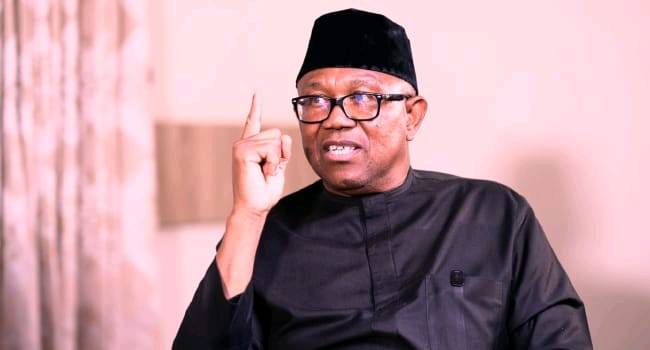
Peter Obi, presidential candidate of the Nigeria Democratic Congress, NDC, claimed in his Independence Day address that more than 140 million Nigerians are living in poverty and severe hardship.
Available data shows that the figure is plausible under some monetary poverty estimates, but it is not established as an official current count of Nigerians living in poverty and severe hardship.
The National Bureau of Statistics, NBS, reported in its 2022 Multidimensional Poverty Index that 63 percent of Nigerians, about 133 million people, were multidimensionally poor. The survey was conducted between November 2021 and February 2022 and measured deprivations including education, healthcare, sanitation, electricity, housing and food security.
More recent estimates have produced higher figures. The World Bank estimated that poverty had risen to about 56 percent, equivalent to roughly 129 million Nigerians, in its 2024 Nigeria Development Update.
The IMF, in its June 2026 assessment, put Nigeria’s poverty rate at 63 percent under the national poverty line. Depending on the population estimate and methodology used, that percentage can translate to roughly 140 million people.
However, the different figures measure poverty differently. Multidimensional poverty is not the same as monetary poverty, and neither automatically means that every person counted is experiencing what Obi described as “severe hardship.”
A recent fact check by Trust Radio therefore concluded that there is substantial evidence of widespread poverty in Nigeria, but that the specific claim that more than 140 million Nigerians currently live in poverty and severe hardship is not conclusively established.
Verdict: Partly true, with qualifications.
The figure of around 140 million is supported by some recent monetary-poverty estimates, but there is no single official survey establishing that exactly or more than 140 million Nigerians currently live in poverty and severe hardship





Leave a comment