


By Benson Daniel
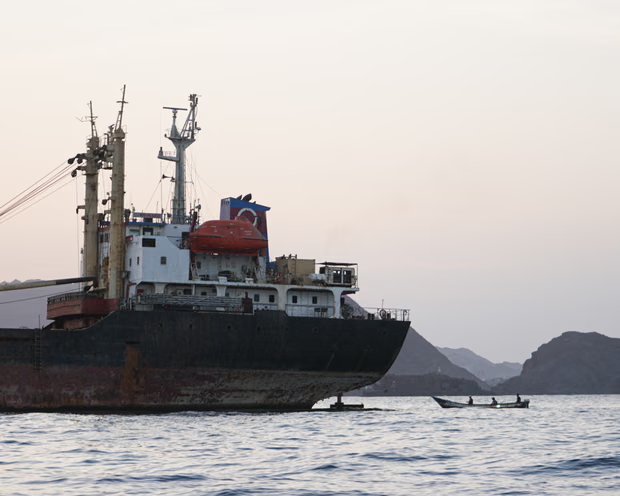
Yemen’s Houthi movement has captured the strategically important Greater and Lesser Hanish islands in the Red Sea, tightening its grip around one of the world’s most important maritime routes and raising fresh concerns about the global oil supply.
The islands, located near the Bab el-Mandeb Strait, give the Iran-backed group a stronger position over shipping routes linking the Red Sea with the Gulf of Aden and the wider Indian Ocean.
The latest advance comes after Houthi forces seized the port of Mokha and Perim Island, further extending their control along Yemen’s Red Sea coastline. The developments have increased concerns over the safety of commercial vessels and the movement of crude oil through the region.
The Bab el-Mandeb is particularly important because it provides a key route between the Red Sea and the Gulf of Aden. Any prolonged disruption could force oil tankers and other commercial vessels to take longer routes, increasing transportation, insurance and fuel costs.
The threat comes at a particularly sensitive time for global energy markets, with the wider Middle East conflict already putting pressure on oil supplies.
Brent crude has risen above $100 a barrel amid growing fears of supply disruptions, with traders increasingly concerned that further escalation could remove additional barrels from international markets.
Saudi Arabia faces particular exposure because it has increasingly relied on routes through the Red Sea to move oil towards international markets following disruption around the Strait of Hormuz.
The situation has been made more serious by damage to Saudi Arabia’s East-West oil pipeline, which transports crude from the kingdom’s eastern oil fields to the Red Sea port of Yanbu. The pipeline is expected to remain largely out of service for several weeks while repairs are carried out.
The combination of the pipeline disruption and growing Houthi control around the Red Sea has left global energy markets with fewer reliable routes for transporting oil.
Analysts have warned that prolonged disruption could develop into a wider oil supply crunch, particularly if attacks spread to tankers or critical energy infrastructure.
The consequences would extend beyond the oil market. Higher crude prices could increase the cost of petrol, diesel, electricity and transportation, while also pushing up the cost of producing and moving food and manufactured goods.
Countries that depend heavily on imported energy could face particularly strong inflationary pressure if the disruption continues.
The shipping industry is also likely to face higher insurance premiums and increased security costs as vessels operating near the Bab el-Mandeb face greater risks. Companies could also be forced to divert ships around the Cape of Good Hope, adding thousands of kilometres to some journeys.
The growing Houthi presence around the Red Sea therefore represents a significant new threat to global trade and energy security.
With the Strait of Hormuz already under severe pressure, further restrictions around Bab el-Mandeb could leave international oil markets increasingly vulnerable to additional shocks.
For consumers and businesses around the world, the immediate concern is whether the latest military escalation remains contained or develops into a prolonged disruption capable of driving energy prices substantially higher.









Leave a comment