


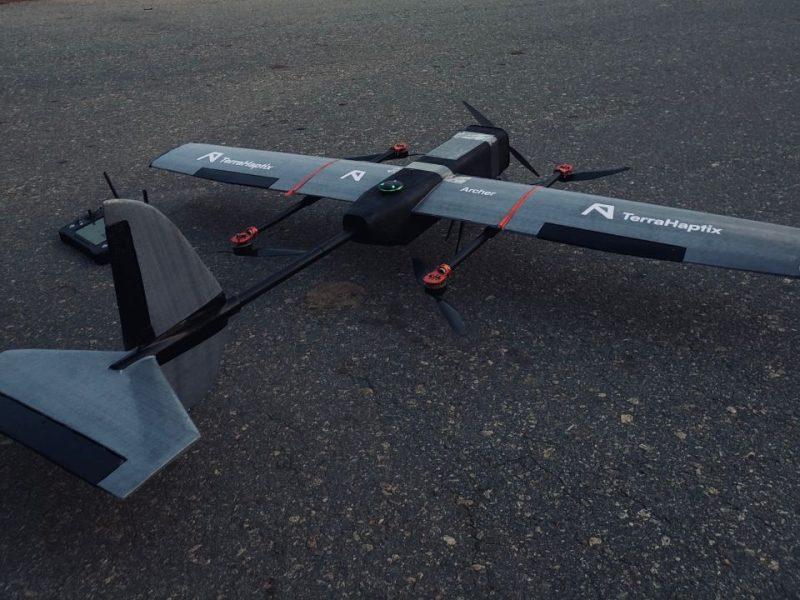
For decades, African nations have relied heavily on foreign suppliers for critical defence technologies, with Turkish drones, Chinese surveillance systems and Russian military hardware playing central roles in securing borders, monitoring strategic assets and supporting military operations across the continent.
That dependence has left many African countries as consumers rather than producers of advanced defence technology. However, a Nigerian technology company is seeking to change that narrative by developing and manufacturing military grade unmanned systems locally.
Founded in 2024 by Nathan Nwachuku and Maxwell Maduka, Terra Industries is an Abuja based defence technology start up that designs and manufactures drones, autonomous surveillance towers and unmanned ground vehicles from production facilities in Abuja, Nigeria, and Accra, Ghana.
Unlike many manufacturers that rely primarily on imported components, Terra says it develops its own flight software, airframes, propellers and lithium ion battery systems, with more than 70 percent of its manufacturing inputs sourced locally.
The company says its technology is currently deployed to protect infrastructure worth an estimated 11 billion dollars, including power plants, oil refineries, lithium and gold mines, and other strategic facilities across eight African countries as well as Canada.
Building Indigenous Defence Capability
As governments across Africa confront insurgency, piracy, illegal mining, cross border crime and attacks on critical infrastructure, demand is growing for locally developed security technologies capable of responding more quickly to regional threats.
Terra’s expansion from protecting private infrastructure to working with Nigeria’s defence institutions reflects this shift in security priorities.
According to the company, its surveillance and unmanned systems are designed to support maritime security, border monitoring and the protection of energy, mining and transportation infrastructure.
“Coastal states in West Africa are focused on maritime surveillance because of piracy and illegal fishing in the Gulf of Guinea,” Terra Industries Chief Executive Officer Nathan Nwachuku told Al Jazeera.
“States dealing with insurgency and porous borders want persistent aerial surveillance and rapid response capability. Others are looking at protecting pipelines, power infrastructure and mining assets, which are the same challenges we began addressing in Nigeria.”
Terra is also planning a significant expansion of its manufacturing capacity.
The company says its second production facility in Ghana is expected to become Africa’s largest drone manufacturing centre, with an annual production capacity of 50,000 drones by 2028.
Nwachuku said the company’s ambitions extend beyond Africa.
“Our long term vision goes beyond the continent because many countries across the Global South face similar security threats and the same dependence on foreign defence suppliers,” he said. “We intend to serve those markets as we continue to grow.”
Strong Investor Backing
Investor confidence in Terra Industries reflects growing international interest in Africa’s emerging defence technology sector.
The company has secured 34 million dollars in seed funding, describing the investment as one of the largest early stage funding rounds for an African technology company.
The funding was led by 8VC, the venture capital firm founded by Palantir Technologies co founder Joe Lonsdale, alongside Lux Capital and Valor Equity Partners, firms known for investing in advanced technology companies including Anduril and SpaceX.
“The funding round closed in less than two weeks, which is unusual even by international standards,” Terra Industries Director of Communications Tage Kene Okafor told Al Jazeera.
“What is even more significant is the calibre of investors supporting us. These are firms that have backed companies shaping the future of defence technology and advanced manufacturing globally.”
Responding to Africa’s Changing Security Landscape
The demand for advanced drone technology has increased as unmanned aerial systems become increasingly prominent in conflicts across Africa.
In the Sahel region, commercially available drones have evolved from surveillance tools into offensive weapons used by armed groups.
According to data from the Armed Conflict Location and Event Data (ACLED), the al Qaeda affiliated group Jama’at Nusrat al Islam wal Muslimin (JNIM), operating primarily in Mali and Burkina Faso, has carried out more than 100 drone attacks since 2023, with 2025 recording the highest number of incidents.
In response to this evolving threat, Terra developed its Kama interceptor drone, designed to detect and intercept hostile drones at speeds of up to 300 kilometres per hour, offering a lower cost alternative where conventional air defence systems may not be practical.
Beyond Manufacturing to Defence Sovereignty
While companies such as Terra demonstrate that sophisticated defence technologies can be designed and manufactured in Africa, experts caution that industrial capability alone does not guarantee defence sovereignty.
Janice Greaver, Director of the Pan African Sustainable Innovation and Development Associates (PASIDA), argues that genuine defence independence also requires transparent institutions, effective procurement systems and public oversight.
“Seventy percent local sourcing means little until we know who controls the intellectual property, who is employed and who is excluded,” she told Al Jazeera.
“And when private capital arms the state without meaningful civil society oversight, we risk replacing one form of dependence on foreign suppliers with another centred on unaccountable domestic interests.”
Terra Industries’ rapid growth highlights Africa’s increasing capacity to develop sophisticated defence technologies while addressing regional security challenges with locally engineered solutions.
Whether that progress ultimately translates into genuine defence sovereignty, however, will depend not only on manufacturing capability but also on how governments regulate, procure and oversee the technologies they increasingly seek to produce at home.
As Greaver concludes, “Manufacturing capacity can be built. True sovereignty requires accountability structures that have yet to be fully established.”










Leave a comment