


The Trump family’s cryptocurrency venture that generated more than $500 million for US President Donald Trump has also become an unexpected diplomatic tool for Pakistan, helping Islamabad gain rare access to the White House despite little evidence that the business partnership has delivered any tangible financial benefits.
According to Trump’s 2025 financial disclosure, World Liberty Financial (WLF), the crypto company backed by the Trump family, earned him more than $500 million from token sales alone last year. Pakistan was among the first countries to engage with the company, signing an agreement aimed at exploring the use of its USD1 stablecoin for cross border payments.
In January, Pakistan’s Ministry of Finance signed a memorandum of understanding with SC Financial Technologies, an affiliate of World Liberty Financial, to examine the potential use of the dollar pegged USD1 stablecoin for international money transfers.
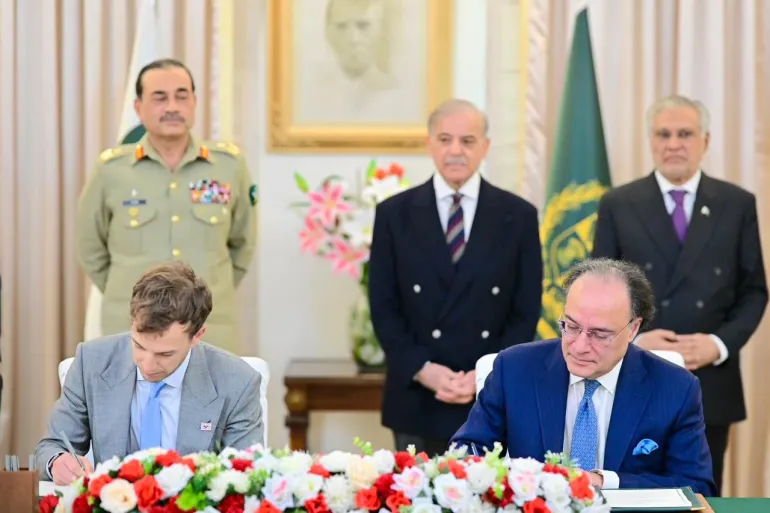
Prime Minister Shehbaz Sharif and Army Chief Field Marshal Asim Munir attended the signing ceremony in Islamabad alongside senior executives from the company, including Zach Witkoff, son of Trump adviser Steve Witkoff. Pakistan’s Finance Minister Muhammad Aurangzeb formally signed the agreement with Witkoff.
However, nearly six months later, Pakistani officials have confirmed that no pilot programme has been launched, no licences have been issued and no transactions using USD1 have taken place in the country.
Despite the absence of practical implementation, analysts believe the agreement has already achieved one of Pakistan’s key objectives by strengthening its political ties with the Trump administration.
Questions Over Practical Benefits
Stablecoins are digital currencies designed to maintain a fixed value, usually by being pegged to the US dollar. World Liberty Financial’s USD1 is backed by dollar reserves, allowing the company and its owners, including the Trump family, to earn interest as adoption increases.
Pakistan is already one of the world’s largest cryptocurrency markets. According to Chainalysis, it ranked third globally last year behind India and the United States in crypto adoption, with much of the country’s activity centred on Tether’s USDT stablecoin.
There is currently no evidence that USD1 has been used in Pakistani financial transactions.
A senior Pakistani banking executive, speaking anonymously, said there is no reliable estimate of how much cryptocurrency is used for remittances because much of the activity occurs through informal channels.
Those informal systems are estimated to account for roughly one tenth of Pakistan’s remittances, although the share involving stablecoins remains unknown.
Meanwhile, Pakistan continues to receive record levels of money through formal banking channels. The State Bank of Pakistan reported that remittances reached a record $38.3 billion during the last financial year, representing a 27 percent increase over the previous year. In May alone, inflows reached an all time monthly high of $4.25 billion, while the central bank expects total remittances to exceed $42 billion this year.
Canada based banking and finance expert Ibrahim Khalil questioned the need for introducing another stablecoin.
“Why are people using USDT in the first place, considering Pakistan is receiving record remittances through the banking channel, and transfers now happen instantaneously in many cases?” Khalil told Al Jazeera. “Whatever the reason, people are avoiding the banking channel. USD1 will not solve that issue if banking channels are involved.”
He also pointed to Pakistan’s limited foreign exchange reserves, which stood at approximately $16.5 billion in late June, enough to cover about two months of imports.
Unless Pakistan’s trading partners accept USD1 directly, Khalil argued, the country would still need to convert the stablecoin into US dollars before using it, creating additional costs rather than improving efficiency.
Regulatory Framework Still Developing
Pakistan has nevertheless moved quickly to establish regulations for digital assets.
The Virtual Assets Act, passed in March, created the Pakistan Virtual Assets Regulatory Authority (PVARA), giving it authority to license cryptocurrency companies and impose prison sentences of up to five years for firms operating without approval.
In April, the State Bank of Pakistan also allowed commercial banks to open accounts for licensed crypto businesses.
However, PVARA is still accepting only preliminary licence applications, with full regulatory guidelines yet to be finalised. Global exchanges Binance and HTX have received no objection certificates and are registered but have not yet been authorised to operate fully.
The anonymous banking executive emphasised that the World Liberty Financial agreement remains exploratory.
“The MoU in question is exploratory, technical dialogue and knowledge sharing, with no commitment to deploy any particular stablecoin,” the official said.
He added that any company meeting Pakistan’s licensing requirements could eventually provide similar services, arguing that “the architecture matters more than the counterparty.”
According to the executive, licensing, banking integration, pilot programmes and nationwide implementation would realistically require several more months.
Diplomacy Takes Centre Stage
While the commercial value of the partnership remains uncertain, many observers believe its diplomatic impact has been significant.
World Liberty Financial executives first visited Islamabad in April, shortly after heightened tensions between India and Pakistan following a deadly attack in Indian administered Kashmir.
Pakistan later nominated President Trump for the Nobel Peace Prize, praising his role in helping ease tensions between the two countries.
Trump also hosted Field Marshal Asim Munir at the White House in June 2025, marking the first time a US president welcomed a Pakistani army chief who was not also serving as head of state.
The memorandum of understanding also preceded the US Israeli conflict with Iran, during which Pakistan sought to position itself as a mediator between Washington and Tehran.
Last month, US Vice President JD Vance publicly credited Munir for helping establish a framework for peace between Washington and Tehran, describing him as a “great statesman.”
Bilal Bin Saqib, chairman of PVARA, previously served as an adviser to World Liberty Financial before joining the Pakistani government. Speaking to Bloomberg earlier this year, he said Pakistan’s cryptocurrency initiative had helped rebuild trust and open new channels of communication with Washington.
The White House has maintained that no conflicts of interest exist.
Neither Bin Saqib, PVARA nor Pakistan’s Ministry of Finance responded to requests for comment.
Karachi based economist Khurram Husain believes the agreement achieved exactly what Islamabad intended.
“The MoU was nothing more than an instrument of access. It had no real policy basis,” Husain said. “Access was the calculation, and it paid off spectacularly. The tangible gains for Islamabad were getting good access to the Trump White House, which was then added to by the diplomacy in the context of the Iran war.”
Khalil reached a similar conclusion.
“My bottom line would be that this whole exercise was pay for access,” he said.
Source: Aljazeera







Leave a comment