


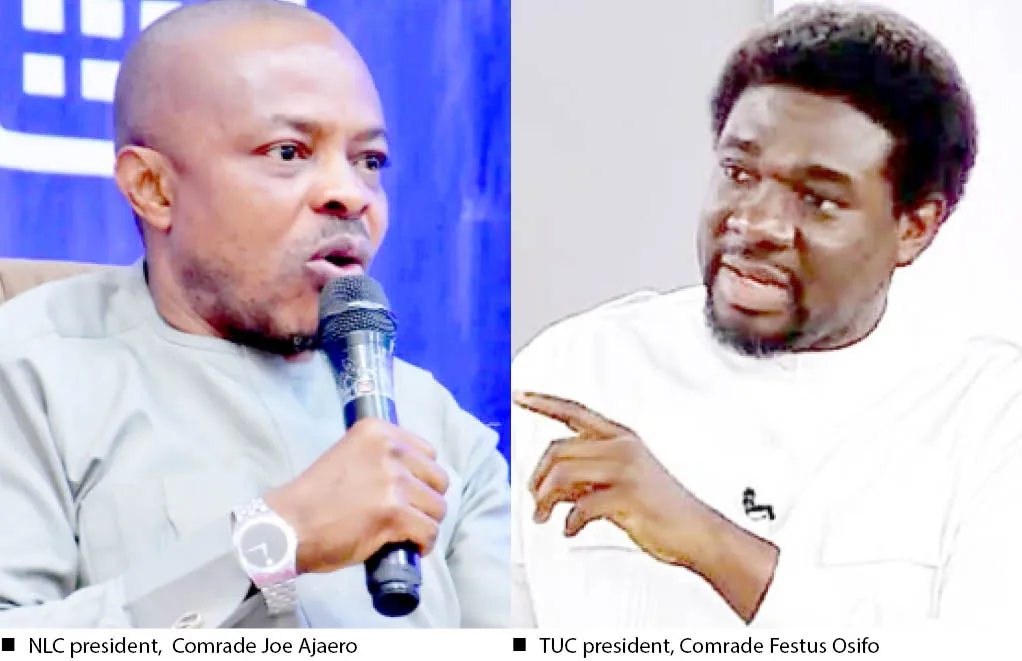
The crisis between the Nigeria Labour Congress (NLC) and the Trade Union Congress (TUC) has deepened following disagreements over the Federal Government’s proposed N70,000 monthly transport allowance for workers.
The dispute has exposed growing divisions between the leadership of the two major labour organisations, with their presidents, Joe Ajaero of the NLC and Festus Osifo of the TUC, exchanging accusations over workers’ representation, negotiating authority and leadership competence.
The disagreement intensified on Monday during separate appearances by the two labour leaders on Channels Television’s breakfast programme.
Ajaero defended the NLC’s decision to negotiate with the Federal Government, insisting that the congress had the authority to represent workers in discussions concerning their welfare.
He explained that the NLC had issued an ultimatum to the government before both parties agreed to meet and negotiate.
According to him, the N70,000 transport allowance emerged from the negotiations following the government’s request for additional time to address labour’s demands.
Ajaero also questioned Osifo’s commitment to his leadership responsibilities, alleging that the TUC president frequently travelled between Nigeria and the United States.
He further challenged Osifo to explain the whereabouts and utilisation of 90 compressed natural gas buses reportedly donated to the TUC by the Federal Government.
However, Osifo rejected Ajaero’s position, insisting that the NLC had no authority to negotiate on behalf of TUC members without the congress’s involvement.
He described the N70,000 transport allowance agreement as unacceptable, arguing that workers needed a sustainable salary increase rather than temporary financial assistance.
Osifo maintained that the TUC was an independent labour organisation with its own affiliates and negotiating structures.
He also questioned the NLC president’s understanding of collective bargaining, describing Ajaero as a disaster to the Nigerian labour movement.
The TUC president insisted that the International Labour Organisation’s principles did not permit one labour organisation to negotiate on behalf of another without proper consultation.
Meanwhile, three public service unions have joined the disagreement, rejecting the position of the Joint National Public Service Negotiating Council (JNPSNC), which endorsed the transport allowance agreement.
The affected unions are the Senior Staff Association of Statutory Corporations and Government-Owned Companies, the Senior Staff Association of Universities, Teaching Hospitals, Research Institutes and Associated Institutions, and the Nigerian Union of Allied Health Professionals.
In a joint statement issued on November 1 and signed by their presidents, Kayode Alakija, John Alli and Kamal Ibrahim, the unions said they were neither consulted nor invited to the meeting where the agreement was reached.
They aligned with the TUC in rejecting the six-month transport allowance, describing it as inadequate amid rising living costs.
The unions also questioned the authority of the negotiating council, warning that it should not operate as another national labour centre alongside the NLC and TUC.
The JNPSNC, however, defended the agreement, explaining that negotiations with the Federal Government produced several commitments beyond the transport allowance.
These include a 40 per cent peculiar allowance reflecting the new minimum wage, payment of outstanding health workers’ allowances and the issuance of a circular on hazard allowances for agricultural officers.
The council said the government also agreed to establish a tripartite negotiation committee to monitor implementation.
The growing disagreement has raised concerns about unity within organised labour, particularly as workers continue to face rising transportation costs, inflation and pressure on household incomes.
ALSO READ:https://vistaonenews.com/2026/11/03/eterna-revenue-hits-%e2%82%a6365-56bn-as-earnings-rise/






Leave a comment